What Living With Cats Teaches Us: A Masterclass in Life, Mindfulness, and Mutual Understanding

If you’ve ever been woken at 5 AM by a persistent paw on your cheek, spent a small fortune on a cat tree only for your feline to prefer the box it came in, or found yourself negotiating with a small creature who owns your favorite chair, you know living with cats is more than pet ownership. It’s a profound, ongoing dialogue with another species.
Living with cats teaches us if we’re willing to learn lessons in consent, mindfulness, independence, and the quiet joy of companionship. This isn’t just about caregiving; it’s about cohabiting with a master of non-verbal communication, a creature whose very nature holds a mirror to our own behaviors and biases. Through their eyes, we relearn how to observe, how to respect boundaries, and how to find contentment in simple moments.
Key Takeaways: The Feline Philosophy at a Glance
Before we delve deeper, here are the core lessons embedded in the feline-human dynamic:
- Consent is Non-Negotiable: Cats teach us to read subtle body language and respect autonomy, a lesson that translates to all relationships.
- The Power of Observation: A cat’s world is built on silent watching. Emulating this can reduce our anxiety and increase our environmental awareness.
- Confidence Without Arrogance: A cat’s self-assured presence is a masterclass in quiet confidence, independent of external validation.
- The Art of Restorative Rest: Their dedication to deep, intentional sleep is a blueprint for managing stress and burnout.
- Communication is Multimodal: From slow blinks to tail flicks, cats use a complex language that challenges us to become better listeners beyond words.
- Living in the Present: Cats don’t dwell on the past or agonize over the future. Their focus is on the immediate moment the sunbeam, the feather toy, the comfort of a lap.
Lesson 1: The Sacred Contract of Consent and Autonomy
A dog’s love is often freely and enthusiastically given. A cat’s trust is carefully, deliberately earned. This fundamental difference is our first and perhaps most vital lesson. Living with cats teaches us to look for the subtle “yes” and respect the clear “no.”
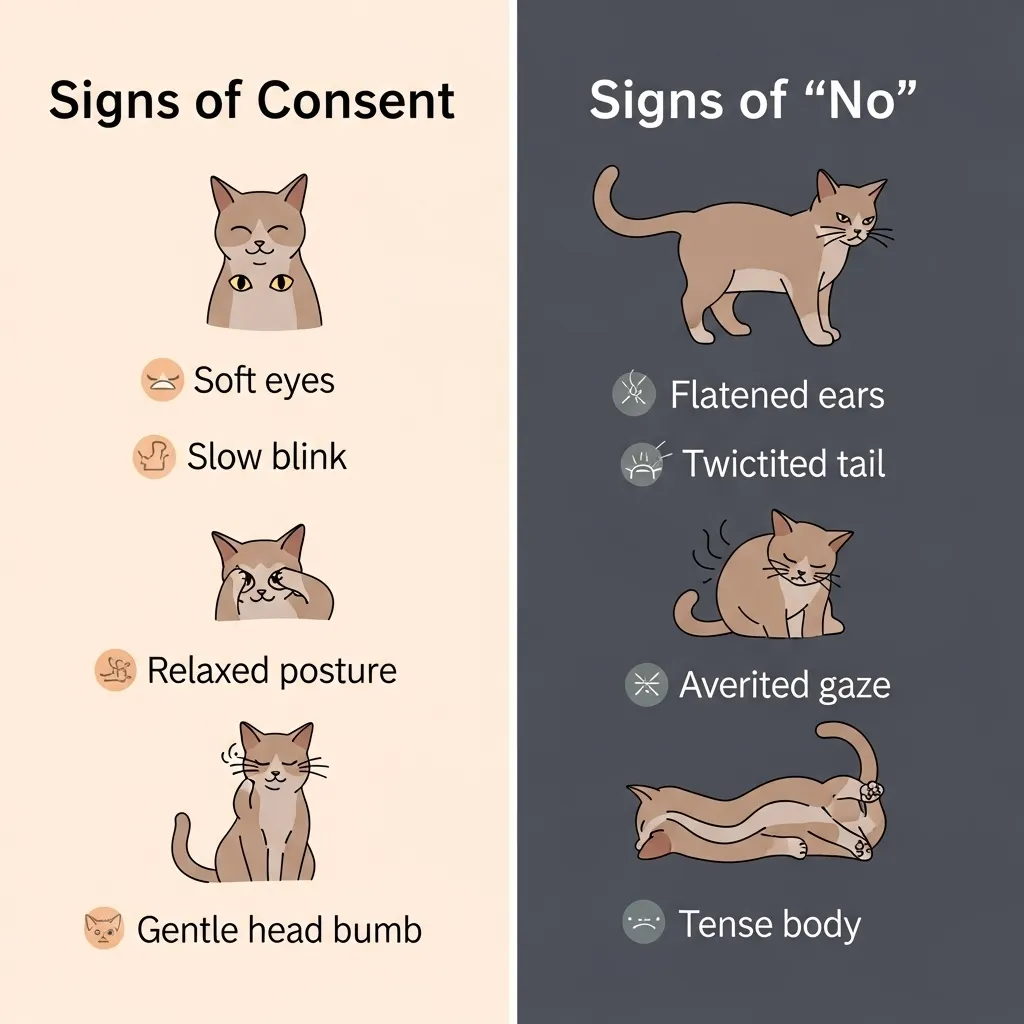
When we reach to pet a cat and they lean away, when we pick them up and they stiffen, they are communicating a boundary. Ignoring these signals forcing affection because we want it breaks trust. Instead, learning to offer a hand for them to sniff, to let them initiate contact, to stop petting before they become overstimulated (often signaled by skin twitching or tail lashing), is a practice in radical respect.
This lesson in consent is profound. It teaches us that love and connection are not about possession or control, but about creating a safe space where another being can choose to be vulnerable. It’s a lesson we can carry into our human relationships: paying closer attention to non-verbal cues, respecting personal space, and understanding that true connection is a choice, not an obligation. For more on understanding these subtle signals, explore our guide on what is my cat thinking.
Lesson 2: The Zen Master’s Guide to Mindfulness and Observation
Cats are the ultimate observers. They can spend hours watching birds, tracking dust motes in a sunbeam, or simply gazing out a window. This isn’t boredom; it’s a form of deep engagement with their environment. Living with cats teaches us to slow down and observe.

In our hyper-connected, stimulus-filled lives, we rarely just watch. We multi-task, we scroll, we plan. The feline practice of observation is a form of meditation. It grounds them in the present. When we join them sitting quietly, watching the world without an agenda we tap into a calming mindfulness. We notice details we normally miss: the play of light, the sound of the wind, the intricate patterns of nature. This practice directly counters anxiety, which often stems from dwelling on the past or fearing the future. Cats, by their very presence, invite us into the “now.” If your cat’s observing turns to stalking or night-time hyperactivity, our guide on how to calm a hyper cat at night offers practical solutions.
Lesson 3: Self-Containment and Quiet Confidence
A cat does not need your approval to be. It exists with a inherent sense of self-worth. It will groom itself with fastidious care, claim its favorite spot with unshakable certainty, and move through its domain with a quiet grace that speaks of self-assurance. Living with cats teaches us about a confidence that comes from within.
Unlike the often performative confidence we see in the human world, a cat’s confidence is not for show. It is not seeking applause. It is simply being. This self-containment is a powerful antidote to our culture of comparison and external validation. Your cat doesn’t worry if the neighbor’s cat has a better scratching post. It is content with what it has, or it calmly works to get what it wants (often by staring at you meaningfully next to the treat jar).
This lesson encourages us to cultivate our own internal sense of worth, to engage in self-care not as a trend but as a dignified routine, and to move through the world with purpose rather than permission. Understanding their unique personality is key; discover how different breeds express this confidence in our cat breeds and personalities breakdown.
Lesson 4: The Vital Importance of Rest and Recharge
Cats are champion sleepers, logging up to 16 hours a day. But this isn’t laziness; it’s strategic energy conservation. As natural predators (even if their biggest hunt is a toy mouse), they are wired for bursts of intense activity followed by prolonged, deep rest. Living with cats teaches us to honor our own need for recovery.

In a society that glorifies “hustle,” the cat is a rebellious icon of rest. They seek out the warmest, softest, most secure spots and surrender completely. They show no guilt for their naps. By observing their sleep habits, we are reminded that rest is not the enemy of productivity; it is its foundation. Quality sleep and deliberate downtime are essential for mental clarity, emotional regulation, and physical health. Your cat’s dedication to sleep is a daily reminder to turn off notifications, create a cozy sanctuary, and prioritize true recharge without apology. For senior cats, rest patterns may change; learn more in our senior cat care guide.
Lesson 5: Mastering Non-Verbal Communication
Cats have a rich, nuanced vocabulary that uses almost no sound. Their tail is a mood antenna. Their ears are radar dishes for emotion. Their eyes can hold a slow-blinking “I love you” or a wide-eyed “I’m overstimulated.” Living with cats teaches us to become expert readers of micro-signals.
We learn that a upright, quivering tail is a joyful greeting. That a tail thumping rhythmically is a sign of irritation. That a slow blink is the ultimate sign of trust and affection—a “kitty kiss.” This forces us to put down our phones and truly look at the being in front of us. It hones our empathy and intuition.
This skill is directly transferable to human interactions. We become more attuned to the crossed arms, the lack of eye contact, the genuine versus the forced smile. Living with a cat trains you to understand that communication is only partly about what is said; it is mostly about what is conveyed through posture, gesture, and energy. Delve deeper into this silent language with our cat tail language guide.
Lesson 6: Unconditional Presence (On Their Terms)
A cat’s affection is not performance-based. They don’t love you because you brought the food; they love you and you bring the food. They offer companionship in a pure, uncomplicated form. When a cat chooses to sit on your lap, it is a moment of pure, present connection. They aren’t thinking about their to-do list. They are fully there, purring, kneading, and sharing warmth. Living with cats teaches us the value of undistracted presence.
This lesson is twofold. First, it teaches us to receive love without conditions to simply enjoy the moment of connection. Second, it inspires us to give our presence more fully. To put away distractions and be truly with our loved ones, human or animal. In a world of constant partial attention, the gift of full presence is rare and profound. This bond is special; explore the signs of a deep connection in our article on cat imprinting signs.
Lesson 7: Adaptability Within Routine
Cats love routine feeding times, play sessions, bedtime rituals. This structure makes them feel secure. Yet, within that routine, they are remarkably adaptable and curious. They explore new bags, investigate rearranged furniture, and find novelty in a simple paper ball. Living with cats teaches us the balance between the safety of structure and the joy of spontaneous curiosity.
They show us that security doesn’t have to mean boredom. We can build a stable, predictable life for ourselves while still leaving room for exploration, play, and new experiences. It’s about creating a secure base from which to satisfy our curiosity a lesson in emotional resilience. Keeping them entertained within this structure is crucial; find ideas in our piece on keep siamese cats entertained.
Lesson 8: The Art of Letting Go (Of Expectations)
You cannot make a cat do anything it fundamentally does not want to do. You can encourage, bribe, and coax, but the final decision is always theirs. Living with cats teaches us the delicate art of letting go of rigid expectations and embracing what is.
You might want a cuddly lap cat, but you have an aloof, independent philosopher. Fighting this reality leads to frustration. Accepting and loving the cat you have, for who they are, is a lesson in unconditional acceptance. It teaches us to appreciate beings and people for their intrinsic nature, not our fantasy of who they should be. This reduces conflict and opens the door to a more authentic, peaceful relationship. This is especially important during introductions; see our cat acceptance of a new kitten guide.
Practical Integration: How to Actively Learn From Your Cat
This isn’t just passive observation. You can engage in this learning:
- Practice the Slow Blink: Try slowly closing and opening your eyes at your cat when you catch their gaze. This is a universal sign of trust and affection. Observe if they return it.
- Respect the “Enough” Signal: When petting, watch closely. At the first sign of tail twitch, ear flick, or restlessness, stop before they feel the need to get away or swat. This builds immense trust.
- Observe Sessions: Dedicate 10 minutes to simply sitting with your cat, not on your phone, just watching what captures their attention. Follow their gaze.
- Create Choice: Offer multiple resting spots, hiding places, and scratching options. Observe which they choose and when. This gives you insight into their preferences and sense of security.
Frequently Asked Questions (FAQ)
Q: Does living with cats actually reduce stress?
A: Scientifically, yes. Studies show that the act of petting a cat can lower cortisol (the stress hormone) and increase serotonin and dopamine. Their purr, which vibrates at a frequency of 25-150 Hz, has even been linked to potential therapeutic benefits for bone density and healing.
Q: My cat isn’t affectionate. What can it teach me?
A: Arguably, an independent cat teaches the most powerful lessons: patience, respect for autonomy, and appreciating subtle forms of connection. Their affection may be sitting nearby, greeting you at the door, or a single, deliberate head bump. It teaches you to value quality over quantity in displays of love.
Q: How does living with multiple cats differ in the lessons taught?
A: Multiple cats add layers of lessons in social dynamics, conflict resolution, and resource sharing. You learn about personality clashes, establishing territory, and the beautiful complexity of non-verbal negotiation between animals. For tips on harmony, read training multi-cat households.
Q: Can these lessons apply to my relationships with people?
A: Absolutely. The core lessons consent, observing non-verbal cues, respecting autonomy, offering undistracted presence, and letting go of expectations are foundational to healthy, respectful human relationships.
Q: What’s the biggest misconception about living with cats?
A: That they are low-maintenance and solitary. They are low-dependency but high-engagement. They require mental stimulation, environmental enrichment, and respectful social interaction to thrive, teaching us that companionship isn’t just about physical care but emotional and intellectual engagement.
The Silent Curriculum of Shared Space
Living with cats teaches us not through lectures, but through a silent curriculum enacted daily on sofas, windowsills, and beds. They are tiny, furry philosophers teaching mindfulness, masters of movement teaching grace, and independent souls teaching the meaning of respectful coexistence. They remind us that communication is deeper than words, that rest is sacred, and that the strongest bonds are built on mutual trust, not control.
In the end, we don’t just train our cats; if we are wise, we allow them to train us to be more observant, more patient, more present, and more kind. We learn to share our space, not just physically, but emotionally, creating a unique interspecies harmony that enriches our lives in quiet, profound ways.

Ready to deepen your understanding and enhance your life with your feline teacher? Explore more expert insights on cat behavior, care, and the unique joys of the feline-human bond in our comprehensive library of guides at Cat Bloom Haven.