How Far Can a Cat Hear? The Real Answer Will Surprise You
Your cat just lifted her head from across the house the second you whispered “treat.”
You swear she heard the bag crinkle from three rooms away, even though you were trying to be sneaky.
You’re not imagining it. Cats possess one of the most finely tuned acoustic systems in the animal kingdom, and the distance they can detect sound is genuinely astonishing.
So, exactly how far can a cat hear?
In ideal conditions, a healthy adult cat can detect high-frequency sounds from as far as 300–500 feet (90–150 meters) away – roughly the length of one and a half football fields. For everyday sounds like your voice or a can opening, the practical range is closer to 100–200 feet, still far beyond what most humans can manage.
Let’s break down the science behind feline hearing abilities, why cats out-hear both us and dogs in key ways, and what it means for daily life with your whiskered roommate.
Key Takeaways (Read This First)
- Cat hearing range: 48 Hz – 85,000 Hz (humans stop around 20,000 Hz)
- Cats hear high-pitched sounds 1.6 octaves higher than humans and 1 octave higher than dogs
- They can pinpoint a sound’s location within 3 inches from over 3 feet away
- Practical detection distance for familiar sounds: up to 200 feet indoors/outdoors
- White cats with blue eyes have a higher risk of congenital deafness

Cat Ear Anatomy: Why Their Ears Are Built Like Satellite Dishes
The secret starts with anatomy.
Each cat ear contains 32 muscles (humans have only 6). This lets them rotate each ear independently up to 180 degrees, funneling sound the way a radar dish tracks a signal. Those little tufts on lynx-point or Maine Coon ears? They’re not just cute – they improve high-frequency detection.
The outer ear (pinna) acts as a parabolic reflector. Sound waves bounce off the curved cartilage and get amplified before they ever reach the eardrum. The middle and inner ear are also specialized for ultra-high frequencies that most mammals simply can’t register.

Cat Hearing Range Compared to Humans and Dogs
| Species | Lowest Frequency | Highest Frequency | Best Sensitivity | Practical Distance for High-Pitched Sounds |
|---|---|---|---|---|
| Human | 20 Hz | 20,000 Hz | 2,000–5,000 Hz | ~50–80 feet |
| Dog | 40 Hz | 60,000 Hz | 4,000–8,000 Hz | ~150–250 feet |
| Cat | 48 Hz | 85,000 Hz | 500–8,000 Hz | 300–500 feet |
Cats sacrifice a tiny bit of low-end bass compared to dogs, but they dominate the ultrasonic zone. That’s why they react to a mouse squeak you’ll never notice or go berserk when you play high-pitched YouTube videos “for cats.”
How Cats Locate Sounds with Pinpoint Accuracy
Ever watched your cat triangulate a bird outside the window?
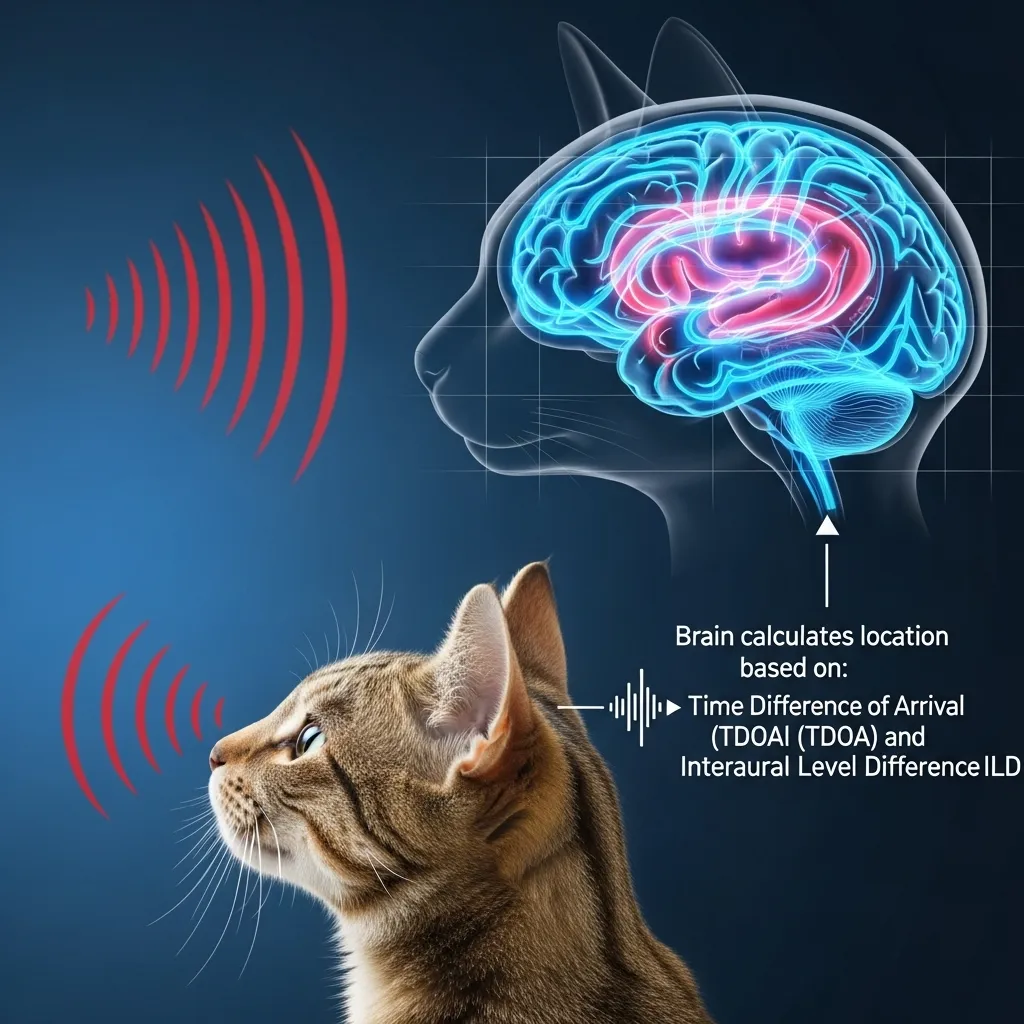
They use three tricks:
- Time difference – sound reaches one ear microseconds before the other.
- Intensity difference – the closer ear hears it slightly louder.
- Pinna shape – the ridges alter tone depending on whether the sound comes from above, below, or behind.
Combined, these let cats locate prey (or the treat bag) within 3 inches from over 3 feet away – better than military sonar in some tests.
High-Frequency Sounds Cats Hear (That You Can’t)
- Mouse and rat ultrasonic squeaks (30–65 kHz)
- Bat echolocation clicks (up to 80 kHz)
- Some electronic devices (old CRT monitors, certain LED drivers)
- High-pitched training whistles marketed for dogs – cats hear them just fine
This is also why “silent” dog whistles drive cats nuts and why some owners swear their cat reacts to thoughts. (Spoiler: it’s usually the tiny high-pitched noise your phone makes when you pick it up.)
Cat vs Dog Hearing: Who Really Wins?
Dogs get the reputation for super-hearing, but cats actually outperform them in two critical areas:
- Higher frequency ceiling (85 kHz vs 60 kHz)
- Better localization of high-pitched sounds
Dogs win on low-frequency detection (earthquakes, distant thunder) and overall stamina for scent-tracking, but when it comes to hunting small, squeaky prey? Cats take the crown.
Why Your Cat Sometimes “Ignores” You
Selective hearing is real. Cats can physically shut their ears using tiny muscles when they decide a sound isn’t worth attention. Combine that with the fact that adult cats often stop responding to their name unless there’s food involved, and you get the classic “my cat pretends I don’t exist” moment.
Research from the University of Tokyo (2013, 2019) shows cats absolutely recognize their owner’s voice and their own name – they just choose when to care.
Want proof? Try opening a can of tuna while calling their name. Suddenly those satellite ears swivel like they’re tracking a missile.
For deeper insight into this behavior, explore our guide on do cats recognize their names.
Are Loud Videos or Music Harmful to Cats?
Yes. Cat acoustic senses are so sensitive that prolonged exposure to sounds above 95–100 dB can cause stress or even temporary hearing damage. Fireworks, vacuum cleaners, and blaring TVs top the list.
Signs your cat is overwhelmed:
- Ears flattened sideways or backward
- Hiding or fleeing the room
- Excessive grooming or shaking head
See our article on protecting cats from loud noises for safe volume guidelines and calming tips.
Age-Related Hearing Loss in Cats
Just like humans, many cats experience gradual high-frequency loss after age 10–12. White cats with blue eyes have a dramatically higher risk of congenital deafness due to a genetic link with the white coat gene.
Early signs of hearing decline:
- No longer reacts to the treat bag or doorbell
- Startles easily when touched from behind
- Meows louder than usual (they can’t hear themselves)
Regular ear cleaning and annual senior checkups catch problems early. Discover safe grooming techniques in our cat grooming and ear cleaning guide.
Cat Ear Infection Signs You Should Never Ignore
Infections or mites can dull hearing fast. Watch for:
- Head shaking or scratching at ears
- Dark, waxy, or foul-smelling discharge
- Redness or swelling inside the pinna
- Tilting head to one side
Untreated infections lead to pain and permanent damage. Learn exactly how to spot and treat them in our complete cat ear infection guide.
How Cats Use Sound in Daily Communication
Your cat isn’t just listening they’re broadcasting too. The position and movement of the ears tell you volumes:
- Forward and upright: curious, happy
- Swiveling: scanning for sound
- Flat sideways: fearful or aggressive
- One forward, one back: conflicted or overstimulated
Combine ear signals with tail language for a full picture – read our popular cat tail language guide.
Protecting Your Cat’s Precious Hearing
Simple habits make a big difference:
- Keep music and TV below 70–75 dB when possible
- Provide quiet hiding spots during parties or storms
- Use puzzle feeders or sound-based toys for mental stimulation without overwhelming volume
- Schedule regular vet ear checks, especially for white or senior cats
FAQ Quick Answers to Common Questions
How well do cats hear compared to humans?
Cats hear roughly four to five times better at distance for everyday sounds and can detect frequencies over four times higher than we can.
What is a cat’s hearing range in feet?
Up to 500 feet for ultrasonic prey sounds in open, quiet conditions; 100–200 feet for familiar household noises.
Do cats recognize their owner’s voice from another room?
Yes. Studies confirm cats distinguish their owner’s voice from strangers’ even when the person is out of sight.
Why does my cat tilt its head when I talk?
They’re adjusting the pinna angle to better locate and analyze the sound – adorable and functional.
Are high-pitched cat videos on YouTube safe?
In moderation and at reasonable volume, yes. Keep sessions short and watch your cat’s body language.
Final Thoughts
Next time your cat bolts toward the kitchen before you even touch the treat jar, remember: those incredible ears just picked up a sound from 150 feet away that you’ll never hear. Their world is alive with frequencies we can only imagine.
Understanding feline hearing abilities doesn’t just satisfy curiosity it helps you communicate better, spot health issues early, and keep your cat comfortable in a noisy human world.
Want more science-backed insights into your cat’s super senses? Explore our full collection of cat senses explained articles right here on Cat Bloom Haven.
Your cat is listening even when they pretend they’re not.