The Silent Language of Love: How Cats Show Attachment Quietly
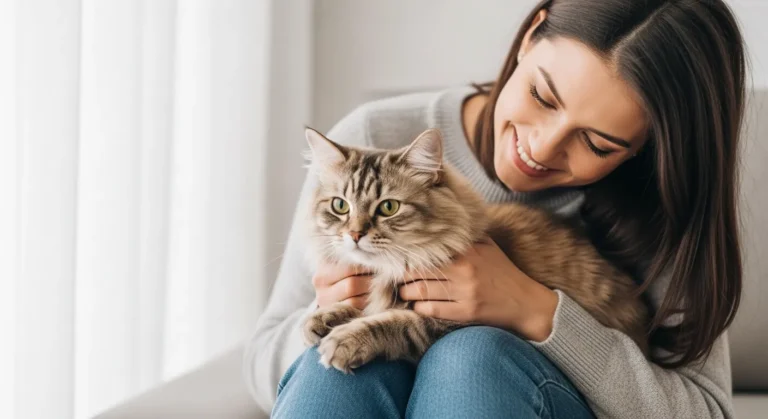
Forget everything you think you know about aloof cats. While dogs wear their hearts on their sleeves, cats whisper their affection through a subtle, nuanced language of quiet gestures, deliberate proximity, and almost imperceptible behaviors. The myth of the indifferent feline persists because we’ve been listening for the wrong things. We expect grand declarations, but cats offer tender sonnets.
Understanding how cats show attachment quietly transforms your relationship with your cat. It turns mysterious aloofness into recognizable devotion. This isn’t about training your cat to be more loving; it’s about learning to see the love that’s already there, expressed in their uniquely feline way. This guide will decode the silent signals, explaining the science behind the behavior and helping you recognize the profound bond your cat shares with you.
Key Takeaways:
- Cats form secure attachments similar to human infants, with their chosen person acting as a “secure base.”
- Quiet attachment behaviors include slow blinking, proximity without demanding attention, scent marking, and gentle physical touches.
- These subtle signs are often misinterpreted as indifference, when they are actually profound indicators of trust and affection.
- You can strengthen this bond by respectfully reciprocating their quiet language of love.
The Science of the Feline Bond: It’s More Than “Just” an Animal
For decades, feline behavior was overshadowed by canine research. The breakthrough came with studies like the one published in Current Biology (2019), which applied the “secure base test” originally used for human infants and dogs to cats. The findings were revolutionary: cats form secure attachments to their caregivers.
In the study, a cat and their owner spent time in an unfamiliar room, then the owner left, and later returned. Cats with secure attachments were distressed when their owner left, but greeted them warmly and returned to relaxed exploration upon their return. Their human was their “safe harbor.” This proves a cat’s bond is not merely transactional (food = love) but emotional and psychological. You are their source of security in a unpredictable world. This foundational trust is what allows all the quiet signs of attachment to emerge.
Decoding the Whisper: 12 Subtle Ways Cats Show They’re Attached
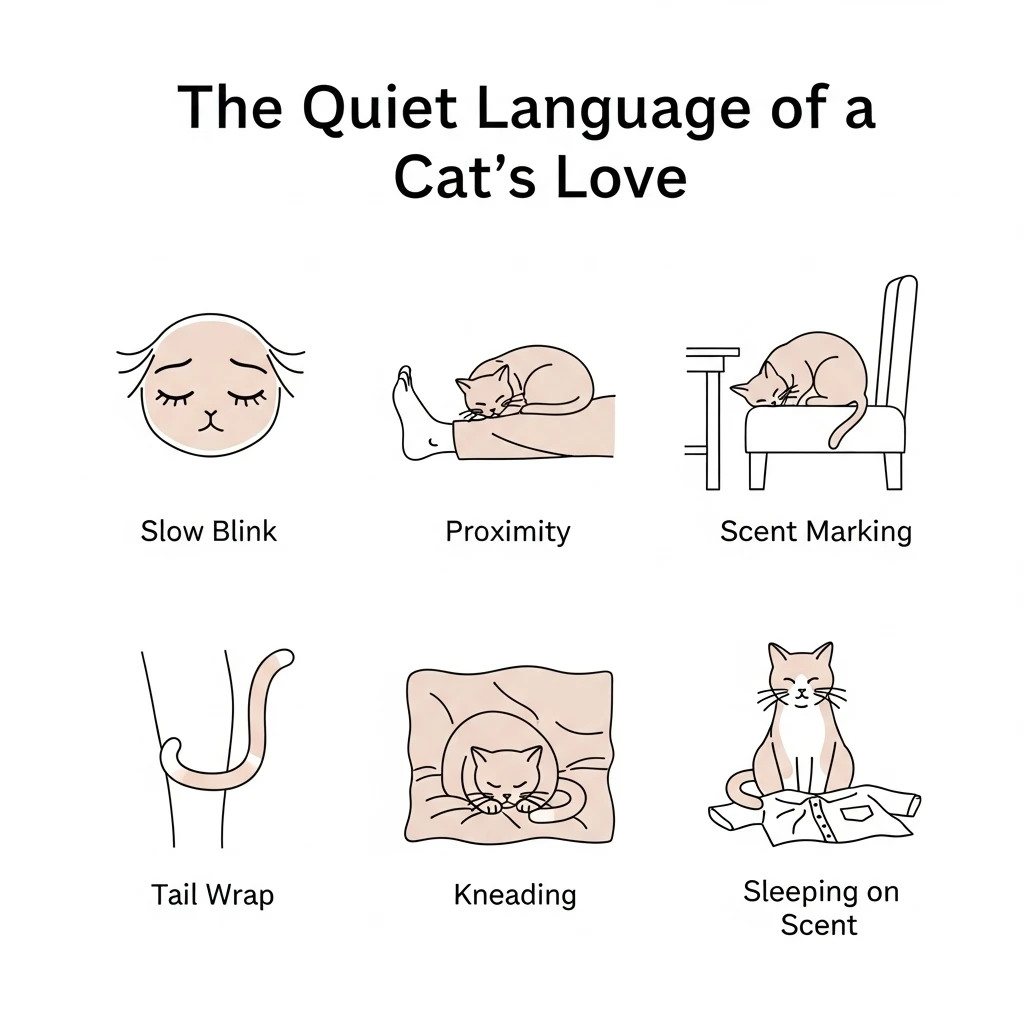
1. The Slow Blink: “I Trust You Enough to Close My Eyes”
This is perhaps the most famous feline “I love you.” When your cat looks at you, softens their gaze, and slowly closes and opens their eyes, they are engaging in cat kissing. In cat language, maintaining a direct stare is a challenge or threat. By slowly blinking, they are signaling that they feel safe and comfortable enough to let their guard down around you. It’s the ultimate compliment.
How to Reciprocate: Try slow blinking back. Gaze softly at your cat, close your eyes for a second or two, and open them slowly. You’re speaking their language, and they often respond in kind.
2. Proximity Without Demand: The Art of “Being With”
A dog might jump on you; a cat will simply exist in your orbit. This is a masterclass in quiet feline attachment. Your cat may not be on your lap, but they are consistently in the same room, curled on a nearby chair, or lying a few feet away on the floor. They seek your presence for comfort, not just for attention or food. It’s their way of saying, “Your company is my peace.”
Real-Life Example: You’re working at your desk. Your cat doesn’t meow or paw at you. Instead, they hop onto the windowsill beside you, curl up, and fall asleep in the sun. This is them choosing your anchored presence as the backdrop to their rest.
3. The Gift of Scent: You Are Marked as “Family”
Cats have scent glands on their cheeks, forehead, flanks, and the base of their tail. When your cat rubs their face or body against your legs, furniture, or even your laptop, they are engaging in bunting. They are depositing their pheromones, marking you and your shared environment as safe, familiar, and theirs. It’s a way of creating a communal scent profile that says, “We belong together.”
What It Means: This is why cats often rub against you when you come home. They are re-mingling your scents after your absence, re-establishing the family bond and reassuring themselves that you are back in the fold.
4. Gentle Tail Touches and Wraps
A cat’s tail is a powerful communication tool. A tail held high with a slight curve at the tip is a greeting of confidence and friendship. When a cat walks past you and deliberately lets their tail curl around your calf or brush against you, it’s a feline version of holding hands. It’s a fleeting, tender connection that says, “I see you, and I’m connected to you.”
Expert Insight: This is distinct from tail twitching or lashing, which indicates arousal or irritation. The attachment behavior is soft, deliberate, and often accompanied by a relaxed posture.
5. Showing the Belly (But Not Always for Rubs)
A cat exposing their belly is showing a tremendous amount of trust. The belly is their most vulnerable area. This display is often a sign of ultimate relaxation and security in your presence. A crucial note: for many cats, this is not an invitation for a belly rub (which can trigger a defensive play-bite). It’s more like them saying, “I am so safe with you that I can let my guard down completely.”
How to Respond: Admire the gesture! You can offer a slow blink or a gentle scratch on the head or chin instead of diving for the belly. Respecting their vulnerability deepens trust.
6. Silent Communication: The Power of a Gaze
An attached cat will often watch you not with a hunting stare, but with a soft, relaxed focus. They track your movements around the house, not out of suspicion, but out of interest and connection. You are the most important feature of their landscape. They may also follow you from room to room, a behavior known as “velcro cat” syndrome, which is the epitome of quiet attachment through shadowing.
7. Kneading: A Kittenhood Holdover of Pure Contentment
Also known as “making biscuits,” this rhythmic paw-pushing is a behavior kittens use while nursing to stimulate milk flow. When an adult cat kneads on you or a soft surface near you, it harks back to this primal state of comfort, safety, and nourishment. It’s a sign of deep, blissful contentment and is often accompanied by purring and a glazed, happy expression. They associate you with that ultimate feeling of safety.
8. Sleeping On or Near Your Possessions
Why does your cat sleep on your pillow, your dirty laundry, or your laptop bag? These items are saturated with your scent. When you’re away, curling up on them is a way to self-soothe with your familiar smell. It’s a quiet, constant way of staying connected to you even in your absence. It’s not just about comfort; it’s about being enveloped in the scent of their secure base.
9. The Quiet, Consistent Greeting
Not every cat is a door-side greeter, but an attached cat will often acknowledge your return in their own way. It might not be a meow or a rub. It could be a glance from across the room, a slight lift of the head, a single slow blink, or the unfurling of a curled-up body. It’s a low-energy acknowledgment that says, “You’re back. My world is back in order.” It’s understated but deeply meaningful.
10. Bringing You “Gifts” (Toys, Not Prey)
While bringing dead prey is a complex behavior (often linked to teaching), bringing you their favorite toy is a clearer sign of attachment. They are initiating shared play, presenting a prized possession, or trying to engage you in an activity they enjoy. It’s a bid for connection and interactive play, showing they see you as part of their social and “hunting” circle.
11. Mirroring Your Routines
An attached cat will often sync with your schedule. They nap when you work, become active when you are up and about, and may even start to anticipate daily events like meal times or your evening TV time. This behavioral synchrony is a subtle sign they have integrated you into the core of their life’s rhythm.
12. Subtle Vocalizations: The Trill and Chirrup
Beyond the standard meow, attached cats often use specific, soft vocalizations for their favorite person. The trill a rolling, melodic sound is frequently used as a greeting. The chirp or chirrup (often heard when they are watching birds) directed at you is an expression of excited interest and a desire to share an experience with you. These are happy, affiliative sounds reserved for those they are bonded to.
For more on feline communication, explore our guide on Cat Tail Language and Why Does My Cat Meow After Eating?.
How to Nurture and Reciprocate This Quiet Bond
Recognizing the signs is the first step. Strengthening the bond involves respectful, cat-centric reciprocity.
- Respect Their Autonomy: Never force interaction. Let them initiate and leave as they please. This reinforces that you are a source of safety, not pressure.
- Initiate the Slow Blink: Make it a habit. It’s the simplest, most powerful way to say “I love you” in cat.
- Provide Choice-Based Affection: Offer a finger for them to sniff before petting. Let them choose the location (chin, cheeks) and duration.
- Engage in Daily Ritualized Play: Use a wand toy to simulate prey. This builds confidence and allows them to express natural behaviors with you as their partner.
- Create a Scent-Safe Environment: Avoid using strong-smelling cleaners on their favorite spots and your own belongings. Your mingled scent is their comfort blanket.
- Become Their Secure Base: Be predictable, gentle, and reliable. Your consistent, calm presence is the bedrock of their attachment.
Building trust takes time. Learn the steps in our Cat Trust Guide.
Frequently Asked Questions (FAQ)
Q: My cat follows me everywhere but doesn’t want to cuddle. Is he attached?
A: Absolutely. Following or staying in your proximity is a primary sign of secure attachment in cats. They seek your presence for security. Cuddling is just one expression of affection, and many cats show love through quiet companionship instead.
Q: Why does my cat stare at me from across the room?
A: A soft, relaxed stare is often a sign of affection and attachment. They are simply content watching their favorite person. If it feels intense, try a slow blink. If they slow blink back, it’s a confirmed “cat kiss.”
Q: How can I tell if my cat is attached to me or just sees me as a food source?
A: Observe behavior outside of feeding times. Does they seek you out for quiet companionship? Do they slow blink, knead, or groom near you? Attachment behaviors are social and emotional, not just food-motivated. A 2019 study confirmed cats view caregivers as more than just providers.
Q: Is it true cats are less attached than dogs?
A: No. They are differently attached. Dogs, through millennia of selective breeding, are overt in their social bonding. Cats, as more recently domesticated solitary hunters, express attachment through subtle, trust-based behaviors. The bond is equally deep but communicated in a quieter language.
Q: My newly adopted cat hides. Does this mean they don’t like me?
A: Not at all. Hiding is a stress response. By giving them space and time, you are allowing trust to build. When they eventually choose to be in the same room as you, even at a distance, that is the first quiet sign of emerging attachment.
If you’re introducing a new cat, our guide on How to Get Your Cat to Accept a Kitten offers valuable tips that apply to adult cat introductions as well.
Conclusion: Learning to Listen to the Silence
The bond with a cat is not earned with grand gestures but discovered in quiet moments. It’s in the slow blink as you read, the weight of them settling near your feet, the faint scent mark on your favorite shoe. By understanding how cats show attachment quietly, you stop waiting for a declaration of love and start hearing the whisper that has been there all along.
This silent language, built on trust, respect, and mutual understanding, forms one of the most rewarding relationships possible. Your cat has chosen you as their secure base, their family. All you need to do is learn to speak back not with your voice, but with your presence, your patience, and a returning slow blink.
Ready to deepen your understanding of your feline friend? Explore more expert insights into cat behavior, care, and the unique bond we share with them in our comprehensive library of guides at Cat Bloom Haven. Discover articles like How Cats Choose Their Favorite Person and Feline Emotions: A Guide to continue your journey into the fascinating world of cats.