How to Introduce a New Kitten to a Cat: The Complete Stress-Free Guide That Actually Works
Bringing home a tiny, bouncy kitten when you already have an older cat feels exciting until you picture hissing, swatting, and two very unhappy felines. The truth? Most introductions fail because owners rush the process and ignore feline nature.
Done correctly, though, 9 out of 10 cats become friends or at least peaceful roommates. This guide gives you the exact slow-introduction method behaviorists and veterinarians recommend, plus the small tweaks that make the difference between weeks of tension and a smooth transition.
Key Takeaways (save these now)
- Never do direct face-to-face on day one. Ever.
- Scent comes before sight; sight comes before touch.
- A proper introduction usually takes 2–8 weeks, not days.
- Separate spaces and resources prevent 90 % of fights.
- Pheromone products (especially Feliway Optimum) speed acceptance by 70 % in studies.
- Watch body language, not just hissing—subtle signs tell the real story.
Why Most Cat Introductions Fail (and How to Avoid the Same Mistakes)
Cats are territorial by evolution. An older cat sees your home as “mine.” A new kitten smells foreign and moves like prey. Sudden meetings trigger fear, not curiosity. Common mistakes I still see daily:
- Letting them “work it out” (leads to trauma and lifelong grudge)
- Free-feeding in shared bowls (resource guarding explodes)
- Skipping scent swapping (delays acceptance by weeks)
- Removing the baby gate too soon (sets progress back to zero)
The fix is simple: control every step so both cats feel safe.
Step 0: Assess Your Older Cat’s Temperament First
Before the kitten even comes home, answer these honestly:
- Has your resident cat ever lived with another cat successfully?
- Does she accept calm visitors or hide?
- Is she confident or easily stressed?
Laid-back or playful seniors (under 9 years) usually adjust fastest. Grumpy seniors or formerly feral cats may need 2–3 months and extra help. Read our deeper dive on older cat temperament here: Explore cat breeds and personalities.
Step 1: Prepare Your Home for a New Kitten (Separate Sanctuary Setup)
The kitten needs a safe base camp for at least the first 7–14 days. Ideal room: spare bedroom or quiet office with door closed.
Must-haves in kitten room:
- Separate litter box (unscented clumping litter)
- Food and water stations far from litter
- Scratching post, hiding spots, vertical perch
- Own toys and soft bedding
- Feliway Optimum diffuser plugged in 48 hours before arrival
Resident cat keeps the rest of the house. This prevents territory loss and reduces stress hormones dramatically.

Step 2: Feline Scent Exchange The Magic That Prevents 80 % of Aggression
Cats identify friend or foe by smell long before they see each other.
Day 1–3 routine (twice daily):
- Pet the kitten with a clean sock on your hand, focusing on cheeks and head.
- Bring sock to resident cat and let her sniff/rub (reward with treat).
- Repeat the opposite direction with a second sock.
- Swap bedding between rooms on day 4–5.
Pro tip: Lightly rub vanilla extract on both cats’ cheeks and base of tail once a day. This “shared scent” trick fools their brains into thinking they already belong together.
Related reading: Cat pheromones and scent swapping explained in depth
Step 3: Site Swapping – Let Them Explore Without Meeting
After 5–7 days of scent exchange, start site swapping:
- Put resident cat in bathroom with treats and toys for 20–30 minutes.
- Let kitten explore the main house (huge confidence booster).
- Then swap back.
- Repeat daily.
Your older cat now smells kitten everywhere but still feels in control because the intruder magically disappears.
Step 4: First Visual Introduction for Cats (Controlled and Calm)
Time: usually week 2.
Options (choose one):
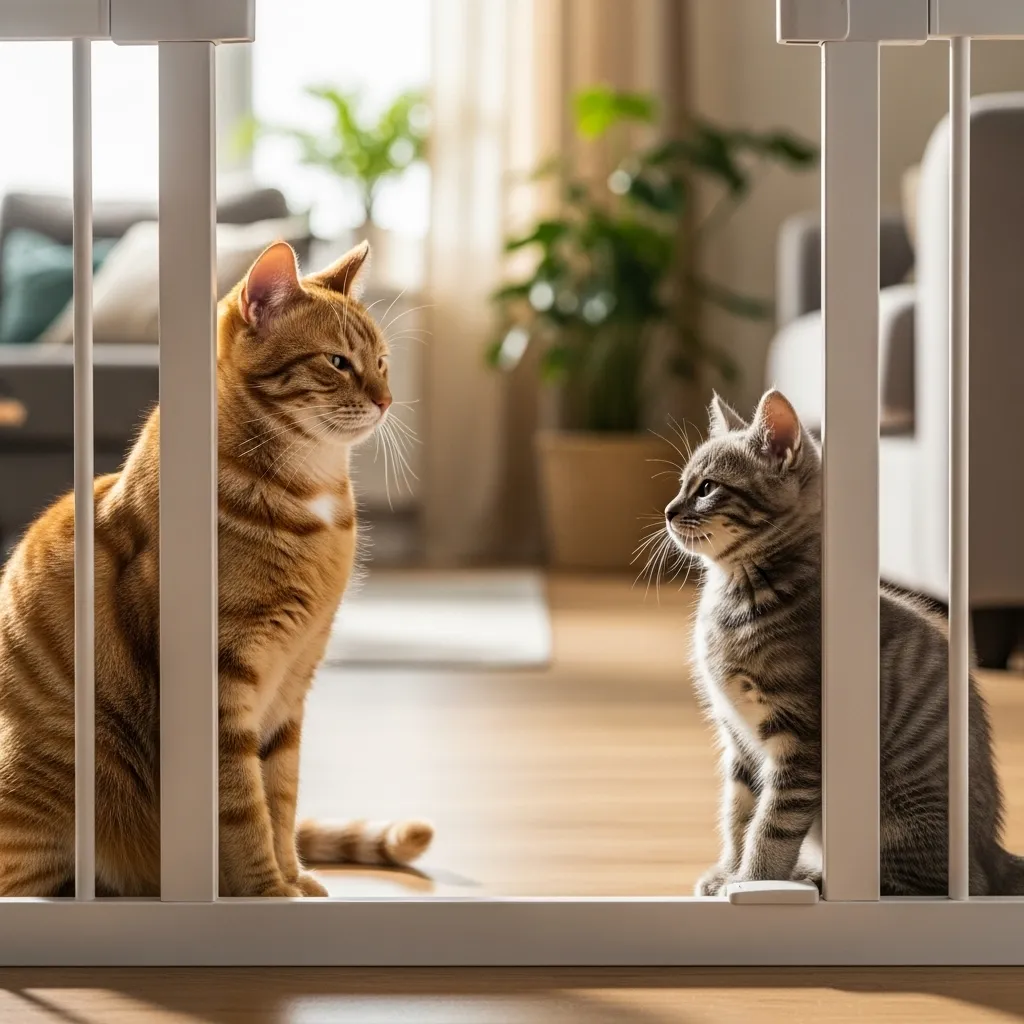
- Stacked baby gates with 2-inch gap (kitten can’t squeeze through)
- Cracked door with doorstop
- Tall pet gate with clear panel
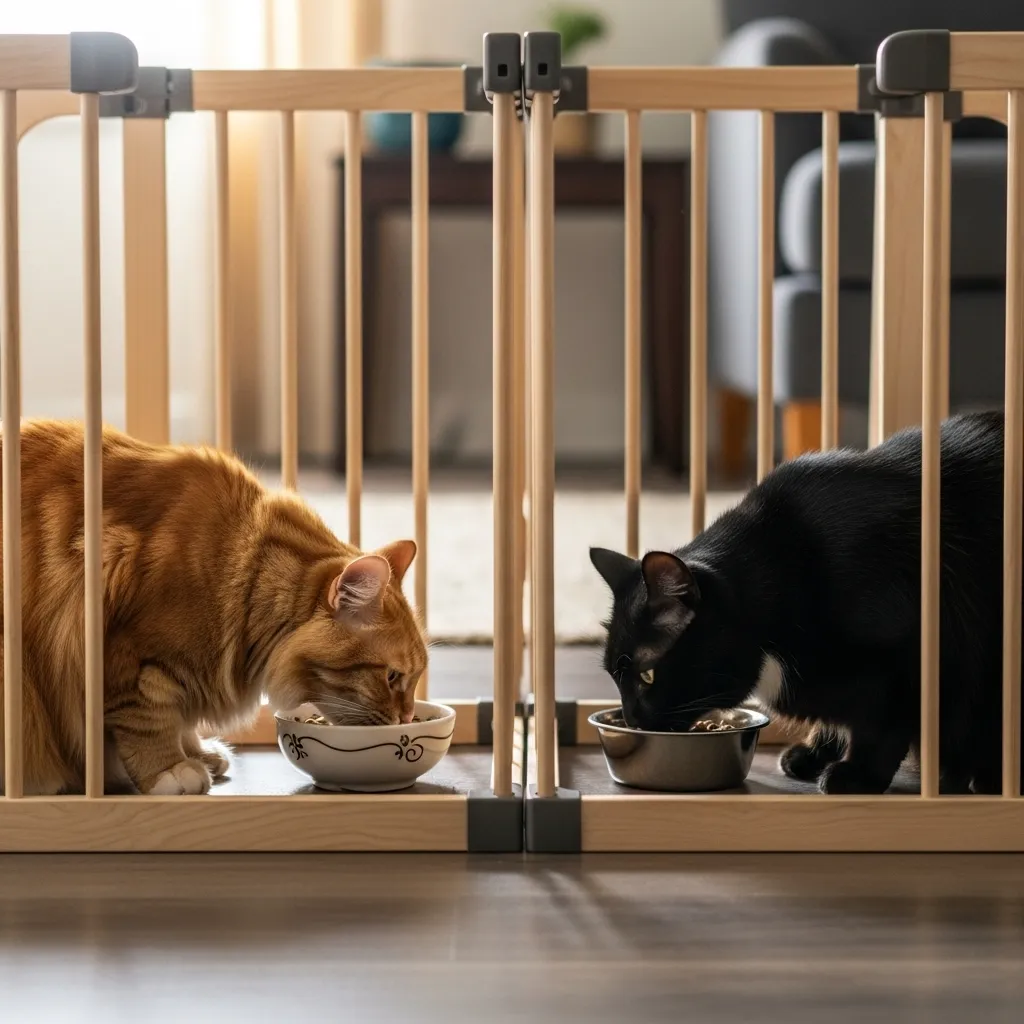
Feed both cats on opposite sides of the barrier at the same time. Start 8–10 feet apart. If tails are calm and they eat, move bowls 6 inches closer next meal. Goal: both eating comfortably 2 feet from barrier.
Signs they’re ready to move forward: loose bodies, slow blinks, curiosity without hissing or growling.
Signs to back up: ears flat, thrashing tail, prolonged staring, lunging.
Step 5: Supervised Cat Introductions – Short and Sweet
First off-leash sessions last 3–5 minutes max.
Rules:
- Both cats freshly fed and slightly tired (post-play).
- Have treats and a blanket ready to toss as distraction.
- Let kitten out in a neutral room (not resident cat’s favorite spot).
- Sit on floor, stay quiet, no direct staring.
- End on first sign of tension, calmly separate and try again tomorrow.
Increase time gradually. Most pairs reach 30-minute peaceful sessions by week 4–6.
Kitten Introduction Timeline – Realistic Expectations
| Week | Milestone | What Success Looks Like |
|---|---|---|
| 1 | Scent swapping & separate rooms | No excessive vocalizing at door |
| 2 | Visual meals through gate | Eating within 3 ft, relaxed tails |
| 3–4 | Short supervised play sessions | Curious sniffing, parallel play |
| 5–8 | Full supervised access | Grooming, sleeping in same room |
| 8+ | Free roaming when alone (if no issues) | Mutual grooming or peaceful coexistence |
Some pairs click in 3 weeks; others need 3 months. Patience beats speed every time.
Using Pheromone Diffusers & Calming Aids (Backed by Science)
- Feliway Optimum or Multicat: plug in both rooms from day -2.
- Composure treats or Zylkene capsules for anxious seniors.
- Solliquin or L-theanine chews for extra nervous cats (vet-approved).
Studies show pheromone therapy cuts aggressive incidents by up to 74 % during introductions.
Positive Cat Interactions How to Encourage Bonding
Once tension is gone:
- Play parallel sessions with wand toys (both chasing same toy builds association).
- Treat parties where both get chicken baby food off spoons at same time.
- Shared high perches so they can watch birds together.
Never force cuddling. Side-by-side napping is already friendship in cat language.
Cat Introduction Mistakes to Avoid at All Costs
- Carrying the kitten into the older cat’s face “to say hi.”
- Punishing hissing or swatting (increases fear).
- One shared litter box (recipe for disaster).
- Removing barriers because “they seem fine for five minutes.”
- Free feeding (older cat guards food, kitten starves).
Signs Your Cats Will Get Along (and When to Call a Pro)
Green flags: slow blinks, tail-up greetings, mutual grooming, play bowing.
Red flags that need professional help: relentless stalking, yowling at night, litter box avoidance, appetite loss over 48 hours.
FAQ Quick Answers
How long for cats to get along after proper introduction?
With the slow method, most pairs reach peaceful coexistence in 4–12 weeks. Lifelong best friends can take 6–12 months.
Can I leave them alone together yet?
Only after 2–4 weeks of consistent calm behavior and no redirected aggression when you’re home.
What if my older cat still hisses after a month?
Go back to scent swapping and gate meals. Add another Feliway diffuser. Book a veterinary behaviorist if no improvement in 2 more weeks.
Do kitten age and resident cat gender matter?
Opposite-sex pairs accept fastest. Kittens under 12 weeks have highest success rate. Two unneutered adults of same sex = hardest.
Should I get two kittens instead of one?
Yes if your resident cat is young and playful. Single kitten + senior cat works fine with this method.
Final Thoughts
Introducing a kitten to an older cat doesn’t have to be chaotic. Control the environment, respect their timeline, and let scent do most of the work. When you finally see them sharing a sunbeam or grooming each other, you’ll know every extra week of patience was worth it.
Ready for more multi-cat household tips?
→ Discover proven ways to stop resource guarding and create harmony: Multi-cat household tips that actually work
→ Struggling with a specific breed? Check our breed-by-breed introduction guides: American Shorthair introductions, Bengal cat introduction tips, Munchkin cat introductions
Your cats deserve a peaceful home. You’ve got this.
Welcome to the Cat Bloom Haven family where every cat blooms.