Why Does My Cat Scratch the Mirror? The Real Reasons Behind This Midnight Drama (And How to Stop It For Good)
If you’ve ever been jolted awake at 3 a.m. by the unmistakable scritch-scratch-scratch of claws on glass, you’re not alone. Thousands of cat owners search “why does my cat scratch the mirror” every single month, especially when the behavior explodes after dark. Your cat isn’t trying to ruin your sleep or your decor; they’re reacting to something that feels very real to them.
In this complete guide, we’ll break down exactly what’s going through your cat’s head when they paw, scratch, or even attack their own reflection. More importantly, you’ll get proven, step-by-step ways to stop the behavior without stress, punishment, or covering every mirror in your house.
Key Takeaways (Read This First)
- Most cats never truly recognize their reflection they see another cat.
- Nighttime scratching usually spikes because low light makes the “intruder” look more threatening.
- The fix is almost always redirection + enrichment, not discipline.
- 9 times out of 10, adding the right scratching alternatives and playtime solves it in under two weeks.
Let’s dive deep into the feline mind and end the mirror madness once and for all.
Why Cats React to Mirrors: The Science Behind the Stare-Down
Cats don’t pass the classic “mirror self-recognition test” that elephants, dolphins, and some primates do. Research from the University of Lincoln and dozens of veterinary behaviorists confirms that the vast majority of cats treat their reflection like a real stranger.
When your cat stares, puffs their tail, or lunges at the mirror, they’re not being dramatic for fun. They’re experiencing one (or a combination) of these triggers:
- Territorial cat behavior
That “other cat” is standing in their territory, mimicking every move. To a cat, perfect synchronization looks suspicious almost threatening. - Mirror aggression in cats
Some cats shift from puzzled to outright hostile. Ears back, piloerection (poofy fur), and hard swats are classic signs of arousal turning into aggression. - Mirror curiosity in cats
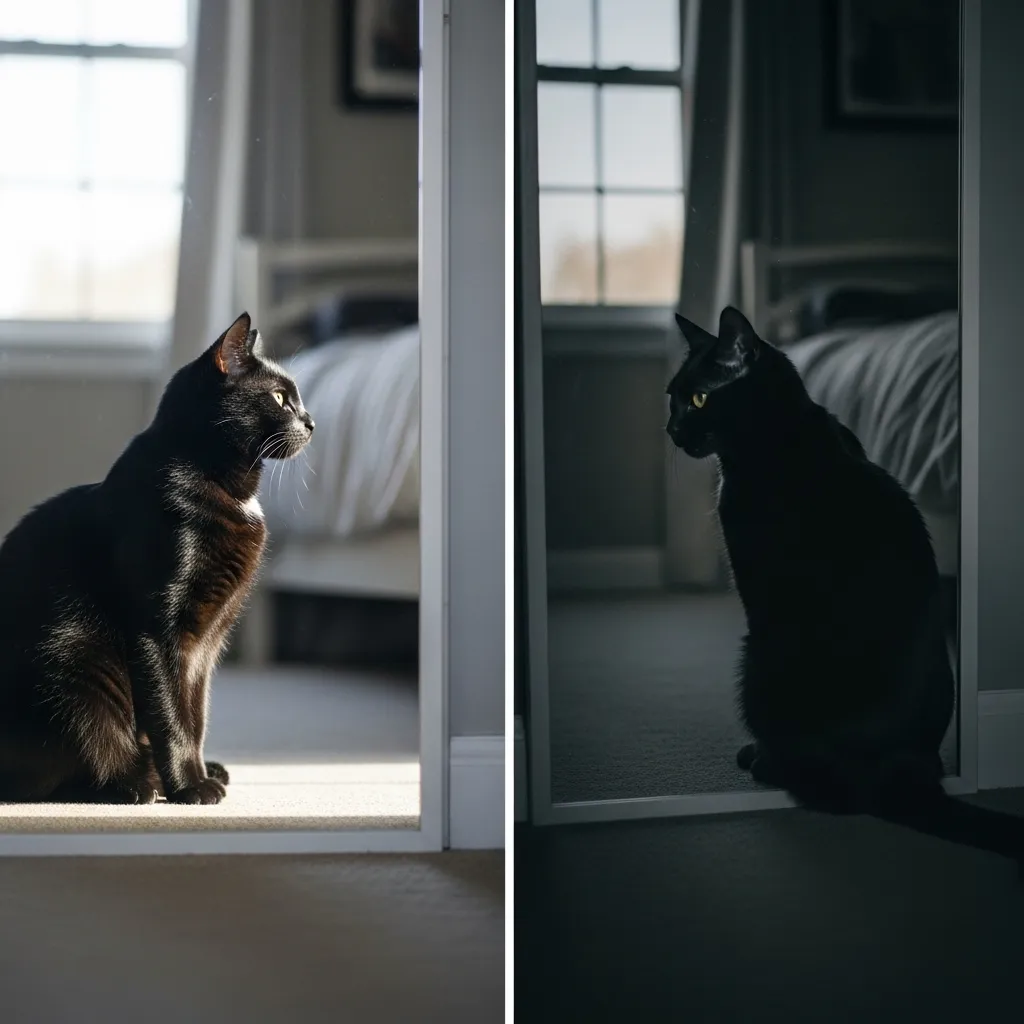
Kittens and younger cats often paw gently at first, trying to figure out if the reflection has a scent or will play. When it never answers, frustration builds. - Low-light confusion
At night, pupils dilate and reflections become dimmer and blurrier. The “intruder” suddenly looks bigger and scarier cue the frantic scratching.
Why the Scratching Happens Specifically at Night
Cat scratching mirror at night is one of the top variations people google, and there’s a clear biological reason:
- Cats are crepuscular (most active at dawn and dusk).
- Indoor lighting creates moving shadows and distorted reflections.
- Boredom and pent-up energy peak when the house is quiet.
- The silence amplifies every tiny sound, making the “other cat” seem more active.
Combine those factors and you get a perfect recipe for midnight mirror attacks.
Related reading: Why cats get aggressive at night
The 5 Most Common Reasons Your Cat Is Scratching the Mirror
| Reason | How It Looks | Emotional State | Likelihood |
|---|---|---|---|
| Perceived intruder | Staring, slow tail swish, hard swipes | Threat / Defense | Very High |
| Playful investigation | Gentle pawing, chirping | Curious / Excited | High |
| Overstimulation or zoomies | Sudden frantic scratching, racing away | Over-aroused | Moderate |
| Boredom / lack of enrichment | Repetitive scratching same spot nightly | Frustrated | High |
| Vision or neurological issue | Head tilting, circling, falling over | Confused / Disoriented | Low (but rule out) |
If your cat shows the last one, schedule a vet check. Sudden mirror fixation can rarely signal vision changes or feline hyperesthesia.
How to Stop Your Cat From Scratching the Mirror Proven 6-Step Plan
You don’t need to banish every mirror. Follow this exact sequence that behavior consultants (including me) use with clients:
Step 1: Break the Association (48-Hour Rule)
Cover the mirror completely for 2–3 days with a lightweight sheet or removable frosted film. This resets the trigger loop. Cats have excellent spatial memory, but 48 hours is usually enough to weaken the habit.
Step 2: Burn the Midnight Energy
Start a 10–15 minute intense play session 30–60 minutes before your bedtime. Use a wand toy that mimics bird or rodent movement. End the session with a small meal the “hunt, catch, kill, eat” sequence tells their brain it’s time to groom and sleep.
See our full nighttime routine
Step 3: Provide Legal Scratching Outlets (Placement Is Everything)
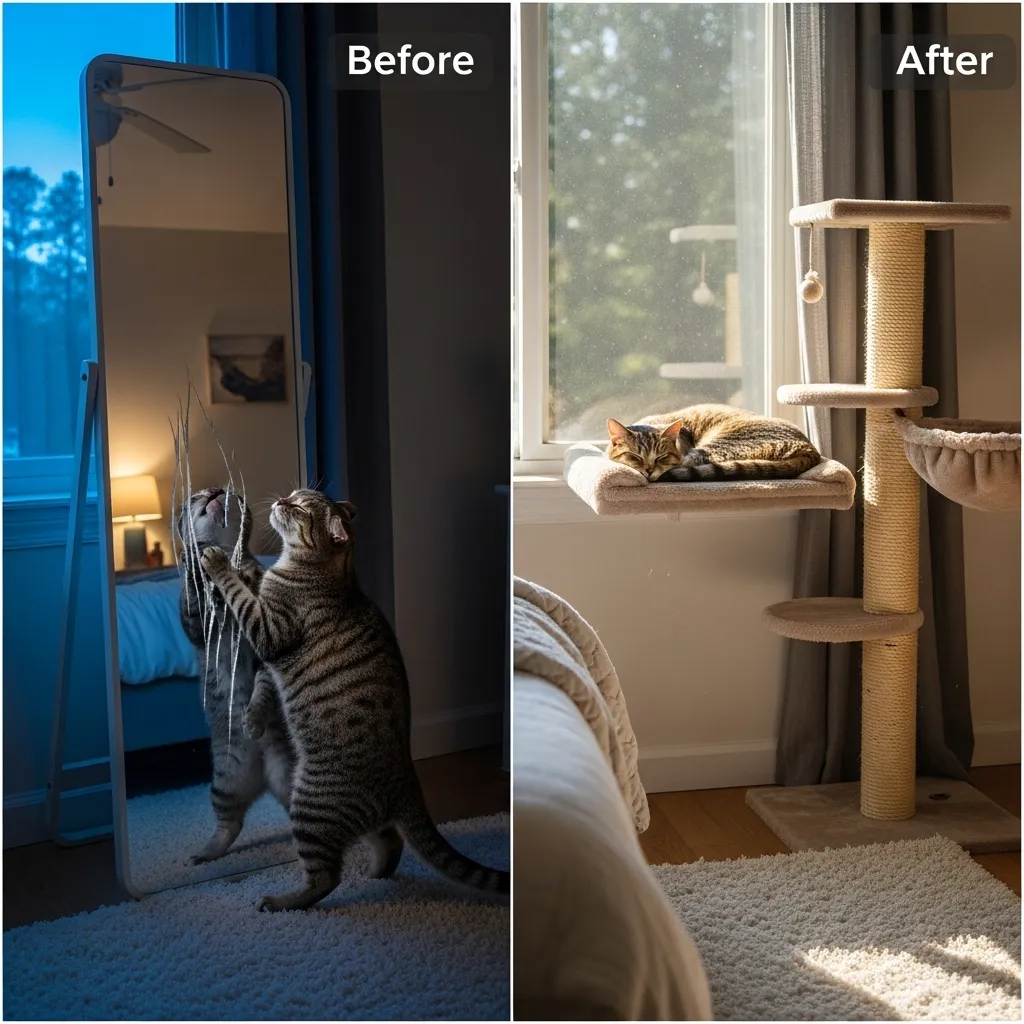
Place a tall vertical scratcher directly beside or in front of the mirror for the first week. Cats want to mark the exact spot where they saw the “intruder.” Give them something better in the same location.
Best choices:
- Cardboard vertical scratchers (cheap and most cats love the texture)
- Sisal-wrapped posts at least 36″ tall so they can fully stretch
- Wall-mounted scratchers at mirror height
Read more: Stop cats scratching furniture complete guide
Step 4: Scent-Swap the Mirror
Rub a soft cloth on your cat’s cheeks (where facial pheromones live) and wipe the lower half of the mirror daily. Now the “other cat” smells like your cat instant de-escalation for territorial scratchers.
Step 5: Diffuse the Tension (Literally)
Plug in a Feliway Optimum diffuser in the room with the problem mirror. Clinical trials show a 33–50% reduction in stress-related behaviors within 7 days.
Step 6: Gradual Re-Introduction
After 7–10 days of zero incidents, remove the cover during the day only. If scratching restarts, cover again and extend playtime. Most cats lose interest permanently within two weeks.
Protect Mirror From Cat Scratching (If All Else Fails)
Sometimes you have an antique mirror or a rental you can’t risk. Quick protective fixes that still look decent:
- Clear corner guards or acrylic sheets cut to size (hardware stores do it cheap)
- Removable static-cling frosted window film (lets light through, blurs reflection)
- Tension-rod curtain in front of the mirror at night only
Understanding Feline Behavior: Do Cats Ever “Figure Out” Mirrors?
A tiny percentage of cats usually older, very social ones eventually ignore their reflection. Viral cat mirror reaction videos make it seem common, but in real life most cats never achieve true self-recognition. They simply learn the “other cat” is harmless and not worth the energy.
Fun related read: Viral cat mirror reactions explained:
FAQ Quick Answers to the Questions Google Sees Most
Do cats recognize themselves in mirrors?
No. Almost all cats treat their reflection as another cat for life.
Why does my cat paw at mirrors gently during the day but attack at night?
Daylight makes the reflection clearer and less threatening. Dim light distorts it and triggers defense.
Is it cruel to let my cat see their reflection?
Not at all, unless it causes chronic stress (rare). Mild curiosity is normal and mentally stimulating.
Will my kitten grow out of mirror scratching?
Usually yes. Kittens explore everything. Most stop on their own by 12–18 months if given proper outlets.
My cat only scratches one specific mirror — why?
That mirror probably has the clearest reflection or sits at perfect cat-eye height. Lighting and background also matter.
Can two cats fighting through a mirror cause real aggression later?
Rarely. They usually redirect frustration to objects, not people or other pets.
Final Thoughts: Your Cat Isn’t Broken Just Misunderstood
Cat scratching mirror behavior looks insane to us, but it makes perfect sense in the feline world. Give them an outlet, tire them out properly, and remove the trigger for a short reset period problem solved 95% of the time.
You’ve now got the exact roadmap that has worked for hundreds of cats (and saved countless mirrors).
Ready for more expert behavior fixes? Explore our full cat behavior library
And if you’re dealing with any other midnight chaos zoomies, yowling, furniture clawing we’ve got you covered at Cat Bloom Haven.
Sweet dreams (finally).