Your Cat’s Secret Superpowers: The Complete Guide to Feline Senses 🐾
Ever wonder how your cat hears the fridge open from two rooms away, or why they suddenly sniff your hand like it holds state secrets? Your feline companion perceives the world in ways you can barely imagine. While we navigate with sight and sound, cats operate on a whole different sensory level. Their world is a rich tapestry of scents we cannot smell, sounds we cannot hear, and subtle vibrations we cannot feel. What seems like quirky cat behavior is actually a sophisticated system of survival and communication, refined over millennia.
Understanding your cat’s senses is more than just fun cat facts for memes; it’s the key to deepening your bond, improving their care, and finally making sense of their most baffling actions. From the jaw-dropping science of cat hearing facts to the delicate whisker perception facts that guide their every move, this guide will transform how you see your furry friend. Get ready to discover the sensory superpowers that make your cat the extraordinary creature they are.
Key Takeaways: A Snapshot of Feline Sensory Superiority
- Super Sniffer: A cat’s sense of smell is 14 times stronger than a human’s, guiding everything from eating to social bonding. Their unique “flehmen response” analyzes pheromones we can’t detect.
- Sonic Surveillance: With a cat hearing range reaching ultrasonic frequencies up to 64 kHz, they can hear a mouse squeak or a treat bag rustle from astonishing distances, with mobile ears acting like satellite dishes.
- Whisker Wonders: Whiskers (vibrissae) are precise tactile sensors, not just hair. They detect minute air currents, measure space, and gauge mood never trim them.
- Specialized Vision: Cats see excellently in low light (perfect for dusk hunting) but have poorer color and detail vision in bright light. Their wide field of view and motion detection make them expert stalkers.
- Integrated Sensory System: These senses don’t work in isolation. A cat hunting uses hearing to locate prey, whiskers to navigate in the dark, smell to confirm identity, and vision to pounce.
The Olfactory Empire: How Cats Rule the World by Smell 👃
A cat’s primary sense is not sight it’s smell. While you might notice last night’s dinner, your cat is reading a complex, layered novel of scent.
The Anatomy of a Super Sniffer
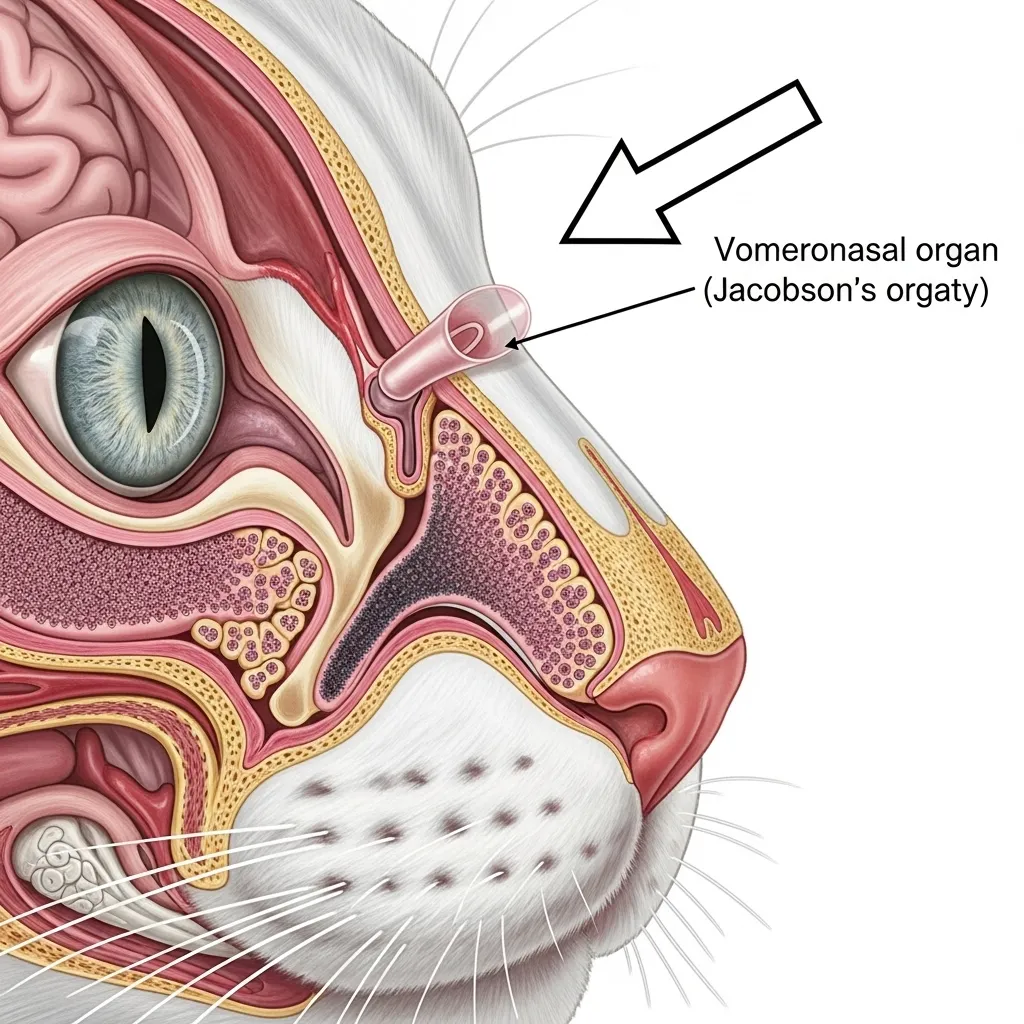
Inside your cat’s nose is a masterpiece of biological engineering. They possess about 200 million odor-sensitive cells, compared to our mere 5 million. This gives them a cat sense of smell vs humans that is approximately 14 times more powerful. But the real secret weapon is the vomeronasal organ (or Jacobson’s organ), located in the roof of their mouth. You’ve seen it in action when your cat catches a scent, opens their mouth slightly, and seems to stare into space a behavior called the flehmen response. They’re not confused; they’re actively channeling scent molecules to this organ to analyze pheromones, the chemical messages of other animals.
What Cats Smell That You Can’t
This incredible ability shapes their entire world:
- Social Mapping: Cats identify each other and you by scent. When your cat rubs their cheek on your leg, they are depositing scent from glands to mark you as “safe” and part of their territory. Conversely, smelling another cat on your shoes is like you walking in with a stranger’s photo.
- Appetite Control: A cat’s appetite is triggered by smell, not taste. This is why cats with respiratory infections often stop eating they literally can’t smell their food. Our guide on cat not eating delves deeper into this serious health signal.
- Stress & Safety: Familiar smells are calming. A new piece of furniture is intimidating not because of its look, but because it carries foreign factory smells. This is also why cats often have strong reactions to scents like citrus or mint, which can be overwhelming or unpleasant to their sensitive noses. Learn more in our article on cats and mint.
Actionable Insight for Cat Owners
- Keep Litter Boxes Clean: A dirty box is a overpowering, offensive odor zone for your cat and can cause them to avoid it.
- Introduce New Items Slowly: When bringing home a new cat tree or bed, allow it to air out, or rub it with a familiar blanket to transfer your cat’s scent.
- Never Use Strong Cleaners or Perfumes in their core areas, as it destroys their scent map and can cause significant anxiety.
Sonic Superpowers: Decoding the World of Cat Hearing 👂
If you think your cat is ignoring you, think again. They likely hear you perfectly they’re just choosing not to respond (a classic cat attitude). Their hearing is a precision instrument for survival.
The Numbers Behind the Ears
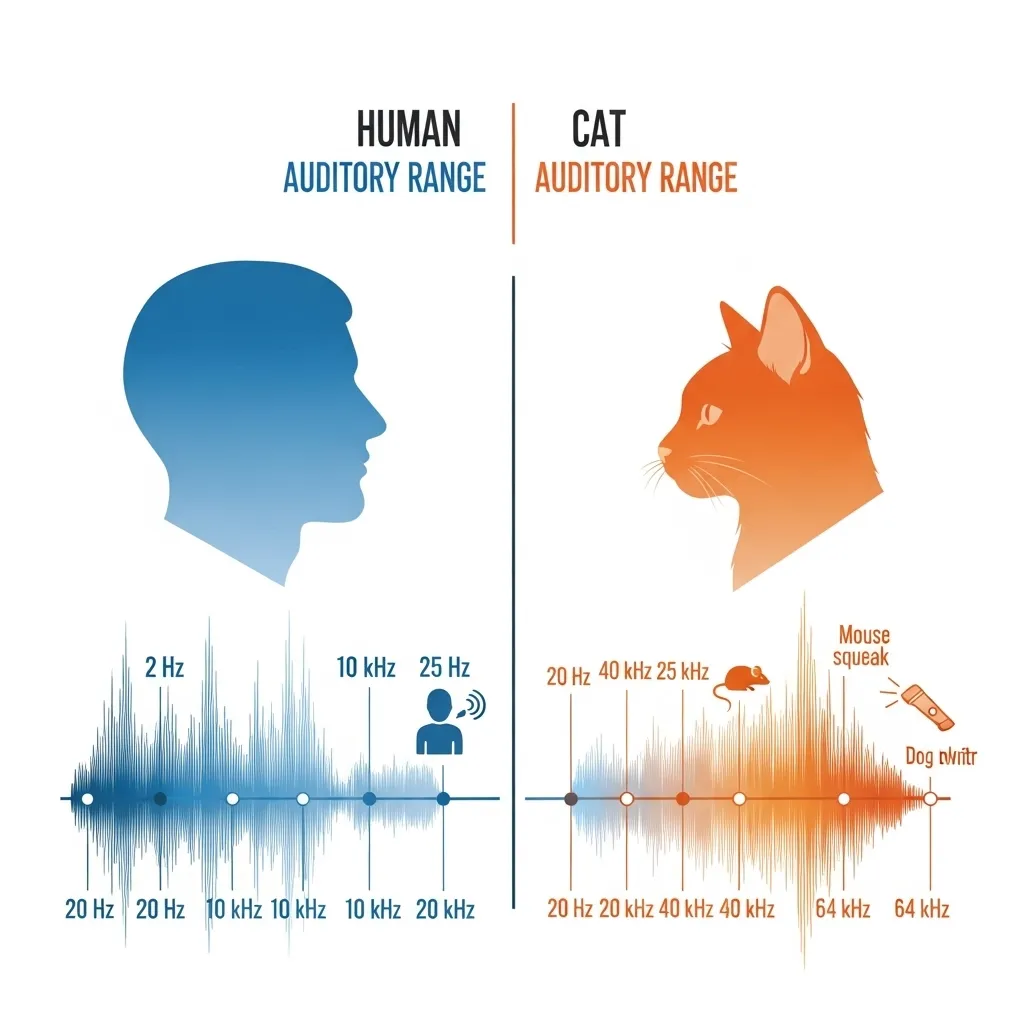
A human’s hearing range tops out at about 20 kHz. A cat’s cat hearing range extends up to 64 kHz, well into the ultrasonic. This allows them to hear the high-frequency squeaks of rodents and the skittering of insects. Their funnel-shaped, mobile ears can rotate 180 degrees independently, acting like parabolic dishes to pinpoint the exact location of a sound within inches. They can hear a can opener from rooms away, but more impressively, they can distinguish between the subtle rustle of a treat bag and the similar rustle of a chip bag.
More Than Just Ears: The Full Auditory System
This sensitivity comes with trade-offs. Loud noises are not just annoying to cats; they can be painful and terrifying. Vacuum cleaners, fireworks, or yelling can be genuinely traumatic. Furthermore, cats use their hearing for spatial awareness. The wide-set of their ears helps them triangulate distance with deadly accuracy, which is why they can leap and catch a toy in mid-air with such grace.
Actionable Insight for Cat Owners
- Provide Quiet Retreats: Ensure your cat has access to quiet, cozy spaces away from household noise, especially during loud events. A comfy bed in a closet or a DIY cat bed in a calm corner can be a sanctuary.
- Watch for Hearing Loss: Senior cats can experience hearing loss. Clap your hands softly behind them (without startling) to test. They may become more reliant on their other senses and startle more easily if approached from behind.
- Communicate with Consistency: Cats learn to associate specific sounds with outcomes. The consistent sound of their food being prepared is a welcome one, while a harsh, unfamiliar sound can be a stressor.
Whiskers: The Silent Guides of the Feline World 📏
Whiskers, or vibrissae, are often misunderstood. They are not just long hairs; they are sophisticated tactile sensors rooted three times deeper in the skin and connected to a super-sensitive network of nerves.
Whiskers as Precision Instruments
The primary function of whiskers is spatial awareness. The whiskers on the muzzle are roughly as wide as the cat’s body, acting as a natural ruler. Before squeezing through a gap, a cat will poke its head in, using its whiskers to gauge if the rest of its body will fit. Whiskers on the legs help with climbing and sensing prey beneath their paws, while the eyebrow whiskers protect the eyes.
They are also exquisitely sensitive to air currents. A cat moving through a dark room can sense the subtle change in airflow around furniture, allowing them to navigate without sight or bumping into things. This sensitivity also helps them detect nearby movement, even in total darkness.
Whiskers and Emotional Barometers
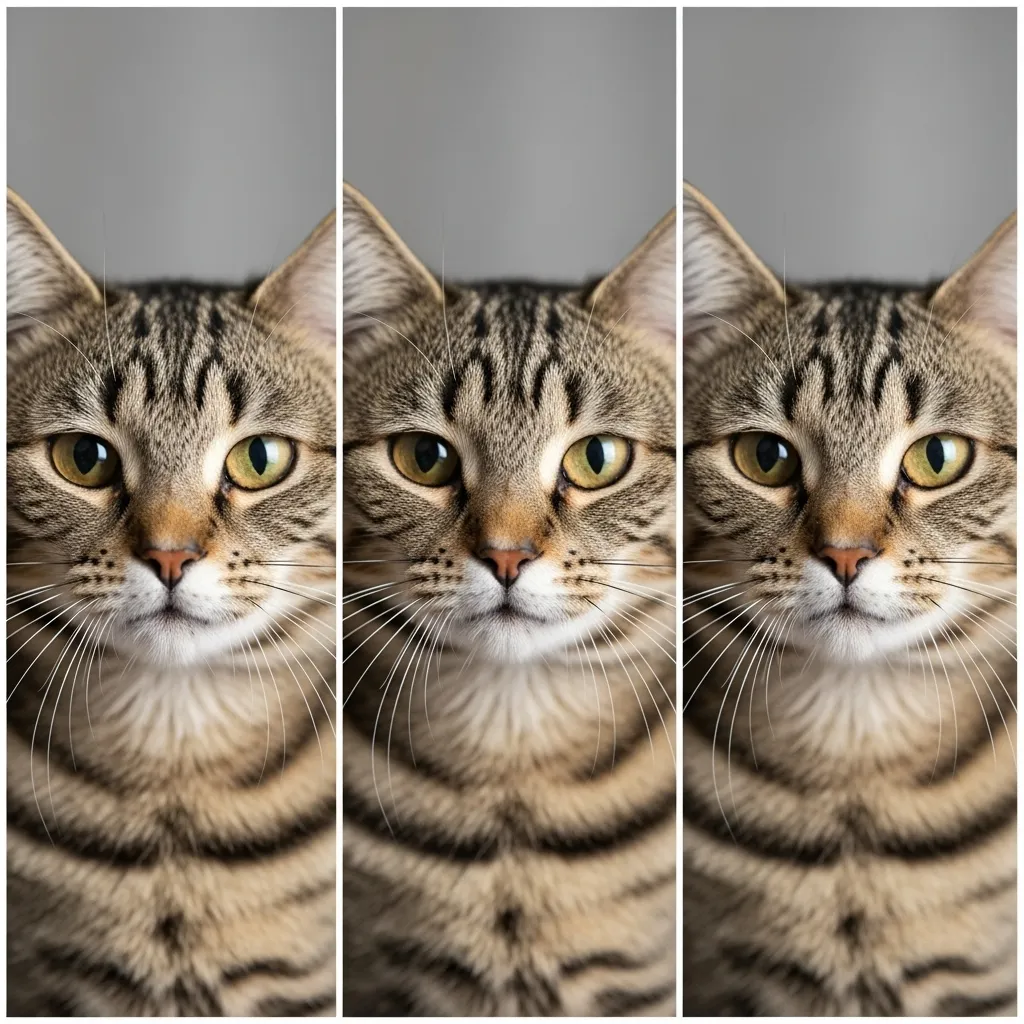
Watch your cat’s whiskers closely. They are a direct window to their mood, a key part of cat communication:
- Relaxed and Forward: Curious, interested, and content.
- Pulled Back Flat Against the Cheeks: Fearful, defensive, or angry. This is often seen during vet visits or confrontations.
- Flared Outward and Stiff: Highly alert, focused, or on the hunt.
Actionable Insight for Cat Owners (The Golden Rule)
- NEVER TRIM OR CUT YOUR CAT’S WHISKERS. Doing so is disorienting, stressful, and like blindfolding them. It can cause them to misjudge spaces and become clumsy or anxious.
- Use Wide, Flat Bowls: Deep, narrow food and water bowls can press uncomfortably against their whiskers, causing “whisker fatigue.” This may be a reason your cat paws food out of the bowl to eat it off the floor. A shallow plate is often preferred.
- Observe for Clues: Paying attention to whisker position can help you understand your cat’s comfort level in any given situation, allowing you to better advocate for their wellbeing.
Vision in the Shadows: How Cats See the World 👁️
Cats don’t see the world in detail like we do, but they see what they need to survive: movement, especially in the dark.
Optimized for the Hunt
Cats are crepuscular hunters, most active at dawn and dusk. Their eyes have a high concentration of rod receptors for low-light vision and a reflective layer behind the retina called the tapetum lucidum (which causes eyeshine). This allows them to see in light six times dimmer than what humans need. However, this comes at the cost of visual acuity and color. Cats see the world in softer focus and with a more muted, blue-and-yellow color palette, lacking our rich red and green perception.
Their field of view is about 200 degrees (compared to our 180), and they are exceptional at detecting the tiniest, fastest movements a crucial skill for spotting a scurrying mouse. However, they are not as good at seeing slow-moving or very close objects; sometimes they use their whiskers to find a treat right under their nose.
The “Weird” Stares Explained
Ever catch your cat staring intently at a blank wall or ceiling? They aren’t seeing ghosts. They are likely tracking the microscopic movement of a dust mote in a sunbeam, a tiny spider, or hearing a critter in the wall that their hyper-focused vision is trying to locate. This intense focus is a pure expression of their cat instincts.
Actionable Insight for Cat Owners
- Play to Their Strengths: Use toys that mimic erratic prey movement a wand toy that darts and jumps is far more engaging than a stationary ball.
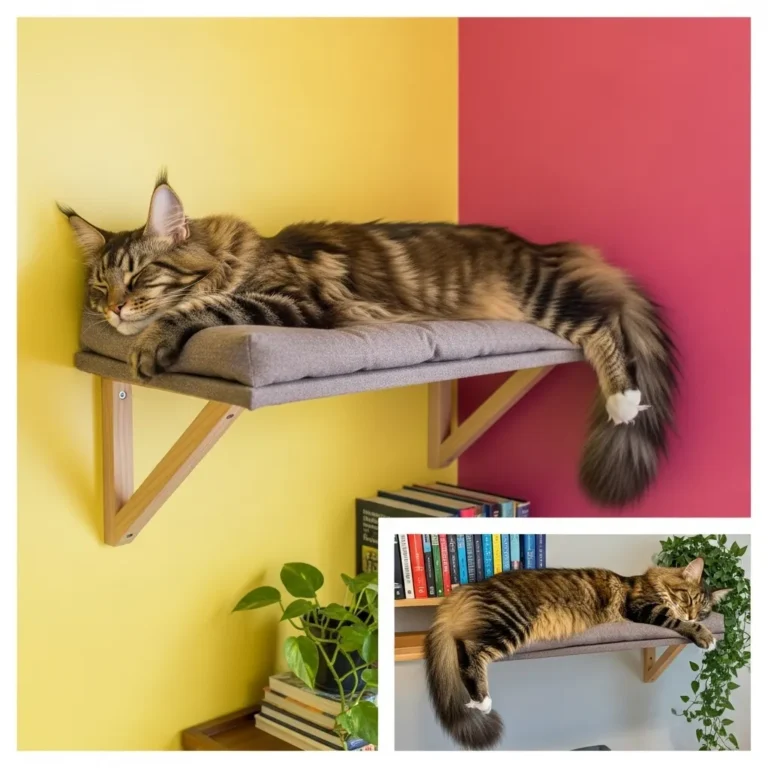
- Provide Vertical Vantage Points: Cats feel secure when they can survey their territory from up high. A cat tree or cat wall-climbing setup satisfies this instinct.
- Understand “The Midnight Crazies”: Those bursts of energy at night are often triggered by their superior low-light vision and hearing picking up on household sounds and shadows we sleep right through.
The Secret Sense: Feline Proprioception & The “Sixth Sense” 🧠
Beyond the five main senses, cats possess an extraordinary sense of proprioception the awareness of their body’s position and movement in space. This is why they almost always land on their feet. A complex system in their inner ear, combined with a flexible spine and no collarbone, allows them to right themselves mid-air in a fraction of a second.
This innate physical intelligence is why they can leap incredible distances, walk silently, and squeeze into impossibly small spaces. It’s not magic; it’s biological precision engineering.
Putting It All Together: A Day in the Life of Your Cat’s Senses
To truly appreciate how these senses integrate, let’s follow your cat through a routine scenario: You opening a new bag of treats.
- Hearing: From the living room, their ears twitch and rotate at the distinctive, high-frequency crinkle of the plastic bag. They’ve distinguished it from other bags.
- Smell: As they enter the kitchen, their nose picks up the specific meaty aroma of the treat, confirming the sound’s promise.
- Vision: Their eyes, though not seeing the fine print on the bag, lock onto the movement of your hand reaching into it.
- Whiskers/Proprioception: As they weave around chair legs at top speed, their whiskers gauge gaps and their body awareness allows for a graceful, silent sprint. They land precisely at your feet, ready for the reward.
Conclusion: Seeing the World Through Your Cat’s Eyes (and Nose, and Ears, and Whiskers)
Your cat is not a small, quirky human. They are a sensory marvel, experiencing a world rich with data that is invisible to us. Every headbutt, every nighttime zoomie, every judgmental stare from a cardboard box is a behavior deeply rooted in their extraordinary perceptual toolkit. By understanding their cat sensory abilities, we stop being baffled by their actions and start appreciating their nature. We become better guardians by providing an environment that respects their sensitivities and enriches their uniquely feline experience.
Ready to understand even more about your fascinating feline? Explore our deep library of expert guides on everything from cat behavior and communication to breed-specific traits and practical care tips on Cat Bloom Haven. Because the more you know, the deeper your bond will bloom. 🌸
Frequently Asked Questions (FAQ)
Q: Why does my cat sniff my face when I come home?
A: They are reading your “scent story” where you’ve been, who you’ve interacted with, and what you’ve eaten. It’s their primary way of gathering information and re-establishing familiarity.
Q: Can I improve my cat’s senses?
A: While you can’t enhance their innate abilities, you can keep them sharp through sensory enrichment. Use puzzle feeders (engaging smell and touch), play with varied sounds (like chirping bird toys), and create a varied environment with safe things to explore.
Q: My cat stares at me and then slowly blinks. What does that mean?
A: A slow blink is a “cat kiss” a sign of trust and affection. You can try slowly blinking back to communicate your love in their language.
Q: Is it true cats can’t taste sweet things?
A: Yes, due to a genetic mutation, cats lack the taste receptors for sweetness. Their taste buds are tuned for meaty, fatty, and high-protein flavors.
Q: Why does my cat get startled so easily by quiet sounds I barely notice?
A: Their ultrasonic hearing picks up high-frequency components of sounds that are inaudible to you, like the subtle squeak of a floorboard or the buzz of electronics. A sound that seems quiet to you may be loud and complex to them.