The Curious Cat at the Kitchen Door: The Hidden Science Behind Feline Mealtime Behavior
If you’ve ever been woken at dawn by a paw tapping your face, serenaded by operatic yowls the moment you step into the kitchen, or watched your cat frantically “bury” a full bowl of food, you’ve witnessed the fascinating puzzle of cat mealtime behavior. To the untrained human eye, these antics can seem bizarre, comical, or even frustrating.
But every meow, every circling dance, every impatient swat is a page from a deeply coded ancestral playbook. This isn’t your cat being “weird”; it’s a complex dialogue of instinct, biology, psychology, and learned communication. In this deep dive, we’ll decode the mysteries of why cats act weird at mealtime, exploring the cat psychology and food connection from every angle. You’ll learn not just what your cat is doing, but why, transforming confusion into understanding and strengthening the unique bond you share.
Key Takeaways: Understanding Your Cat’s Food Rituals
Before we explore the depths of feline behavior science, here are the core insights you’ll gain:
- Instinct is Everything: Behaviors like food-hiding, begging, and pre-meal zoomies are rooted in survival strategies from your cat’s wild ancestors.
- Communication is Key: Meowing, pacing, and staring are deliberate communications tailored to you, not random acts.
- Routine is Sacred: Cats are crepuscular creatures of habit. Their internal clock governs their cat feeding instincts with precision.
- Psychology Matters: Anxiety, competition, and even boredom can dramatically alter cat eating habits.
- Health Can Be a Factor: Sudden changes in cat feeding behavior can be the first sign of underlying medical issues.
1. The Primal Purr-spective: Instincts Hardwired for Survival
To understand the modern house cat at mealtime, we must first look to the wild. Your living room lion is only a few thousand years removed from solitary, opportunistic hunters. This evolutionary legacy is the foundation of nearly every strange cat behavior explained.
The Solitary Hunter’s Paradox
Unlike pack animals, wild cats couldn’t afford to gorge at a communal kill. They ate small, frequent meals—10-20 tiny prey per day. This explains why many cats prefer multiple small servings over one large feast. Their stomachs are small, and their digestive systems are designed for this pattern. When your cat seems to eat a little and walk away, only to return later, it’s following this ancient, ingrained rhythm. For more on matching food to instinct, see our guide on choosing cat food.
The “Burying” Ritual: Saving for Later or Hiding from Rivals?
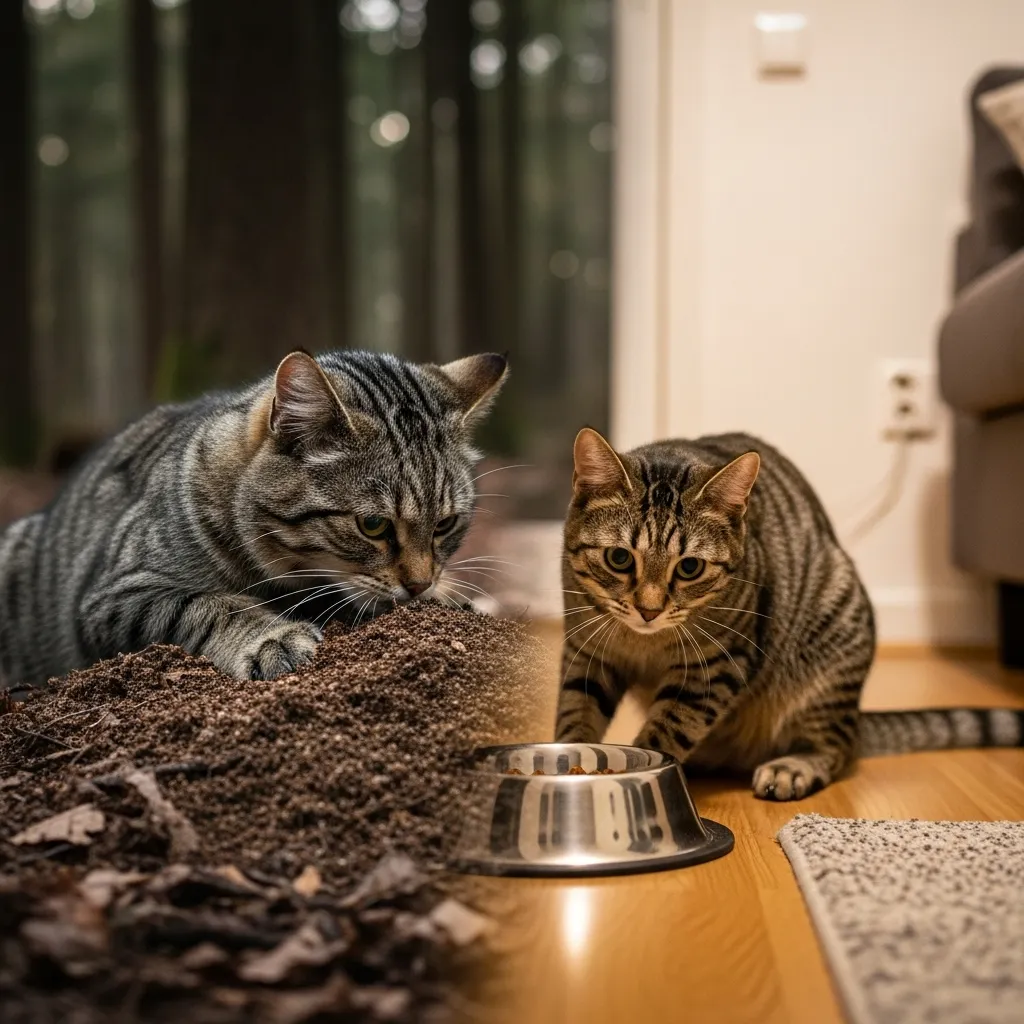
One of the most common things cats do before eating (or after) is that curious scratching motion around the food bowl. This isn’t an attempt to use an imaginary litter box. In the wild, cats would bury leftover carcasses to conceal the scent from larger predators and rivals, and to preserve it (somewhat) for a future meal. Your cat’s ritualistic scratching is this very instinct in action—an attempt to “cache” the resource and keep their territory safe. If you have a multi-cat household, this behavior can be more pronounced due to perceived competition. Learn about dominant cat behaviors to better manage multi-cat dynamics.
The Prey Sequence: Play, Kill, Eat, Groom, Sleep
Observe your cat’s entire routine. You’ll likely see a burst of energy (cat zoomies) before eating, mimicking the “hunt.” After eating, they often engage in a fastidious grooming session (the “cleanup”), followed by a long nap. This is the complete feline instincts sequence playing out in your home. Denying the “hunt” through interactive play before meals can satisfy this instinctual drive and prevent pestering.
2. The Symphony of Meows: Decoding Feline Communication
Cats are master communicators, and they quickly learn what works on their human staff. Why cats meow for food is a brilliant example of cross-species adaptation.
The Evolution of the “Food Meow”
Adult cats rarely meow to communicate with each other. This vocalization is almost exclusively reserved for humans. Kittens meow to their mothers, and in our homes, cats retain this persuasive, infant-like call because it works. They have learned that a specific pitch, volume, or persistence triggers a feeding response from you. It’s a trained, two-way communication.
Beyond the Meow: The Full Repertoire
Pay attention to the subtleties:
- The Chirp-Trill: Often heard as they lead you to the kitchen, a sound of excitement and anticipation.
- The Persistent Yowl: Usually indicates high urgency or frustration (“My bowl is visibly empty!”).
- Silent Meows & Stares: The intense, silent communication paired with a fixed gaze is a powerful, focused request. Discover more on what is my cat thinking during these quiet moments.
- Pacing & Figure-Eights: This herding behavior directs you along the desired path to the food source.
3. The Inner Clockwork: Circadian Rhythms and Routine
Cats are crepuscular most active at dawn and dusk, the prime hunting times. Their internal clock is incredibly sensitive. This is the primary reason cats beg for food at 5 AM with unerring consistency. Light changes, household noises, and your own routine reinforce this schedule.
The 5 AM Wake-Up Call: It’s Not Spite, It’s Science
When your cat wakes you at dawn, it’s following a potent biological imperative. The low light conditions feel like “hunt time.” If this behavior is problematic, the solution lies not in punishment, but in routine adjustment: automated feeders for dawn, or a substantial play-and-feed session right before your bedtime to align their schedule closer to yours. Explore our cat feeding schedule guide for practical strategies.
4. The Psychology of the Bowl: Anxiety, Competition, and Quirks
Cat feeding behavior is deeply tied to emotional state. A stressed or anxious cat may eat too fast, avoid eating, or exhibit guarding behaviors.
The Vulnerable Moment
In the wild, eating is a vulnerable act. Your cat’s preference for a quiet, safe, low-traffic location for their bowl is a direct reflection of this. Placing a bowl in a noisy hallway or next to a rattling appliance can cause cat hunger behavior that seems finicky they’re simply too stressed to eat.
Multi-Cat Household Dynamics
Competition is a major stressor. Signs include one cat eating too fast, one cat stealing food, or a cat leaving the bowl to eat elsewhere. The solution is separate, spaced-out feeding stations, even in different rooms, to mimic the safety of solitary eating. Our article on stop cat eating other cats food offers detailed steps.
The “Pawfect” Picker: Why Some Cats Dine with Their Hands
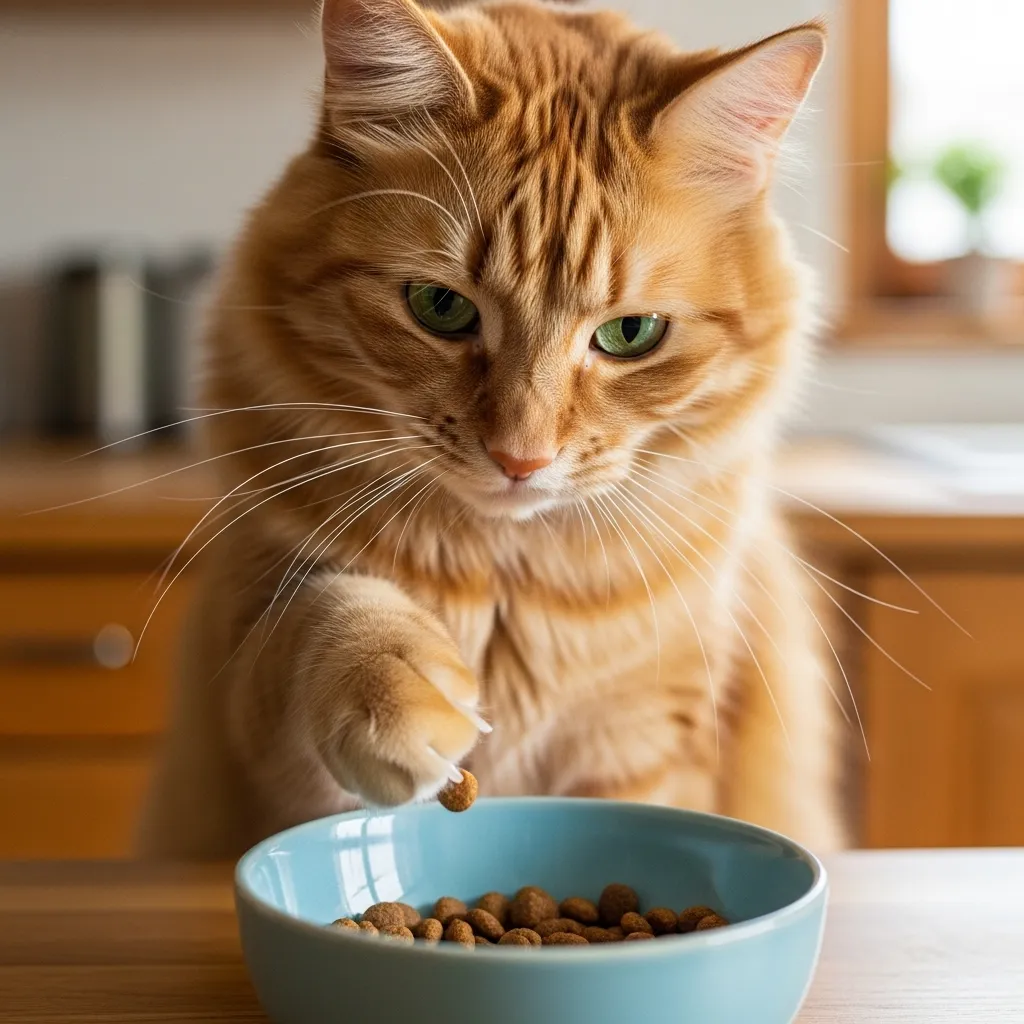
Some cats scoop kibble out with their paw to eat it off the floor. This can be due to whisker stress (a bowl that touches their sensitive whiskers), a dislike of the bowl’s material, or simply a quirky personal preference. Try a wide, shallow dish. This is one of many cat behavior explained quirks that has a simple fix.
5. When Quirks Signal Concerns: Medical Red Flags
A sudden, drastic change in cat mealtime behavior is your first clue that a veterinary visit is needed.
- Increased Vocalization & Begging: Could signal hyperthyroidism, diabetes, or malnutrition from parasites.
- Ravenous Appetite but Weight Loss: A major red flag for conditions like hyperthyroidism or diabetes.
- Avoiding Food/Difficulty Eating: Dental disease, cat stomatitis, or gastrointestinal issues.
- Eating Non-Food Items (Pica): May indicate nutritional deficiencies or compulsive disorders. Read our cat pica guide.
Always rule out health problems first with your vet when behavior changes abruptly.
Frequently Asked Questions (FAQs)
Q: Why does my cat meow after eating?
A: This is often a “thanks” or a contentment vocalization. It can also be part of the social bonding ritual with you, their provider. Alternatively, it could signal that they are still hungry or have a medical issue like worms preventing proper nutrient absorption. If it’s a new behavior, consult your vet.
Q: Why does my cat scratch the floor near its bowl?
A: As explained, this is an instinctive caching or burying behavior. They are attempting to hide the scent of the food from potential “competitors” (even if it’s just your other pet or an imaginary threat) or to save it for later. It’s a completely normal cat instinct and habit.
Q: Is my cat begging because I’m underfeeding them?
A: Not necessarily. First, check with your vet to ensure the feeding amount is appropriate for their age, weight, and activity level. Often, begging is about behavior, not hunger. They may be bored, seeking attention, or simply have trained you to respond. Ensure they have ample play and enrichment.
Q: Why does my cat follow me to the kitchen but not eat?
A: This is likely about routine, curiosity, and companionship. The kitchen is the source of good things, and your cat wants to be part of the action. It may also be a form of social bonding or a learned behavior that sometimes results in treats.
Q: How can I stop my cat from waking me up for food?
A: Break the association between you waking up and food appearing. Use an automatic feeder for the first morning meal. Never feed them immediately when you get up. Instead, establish a routine of play, then food later in the morning. Consistency is critical. For more on night-time antics, see cat howling at night.
Conclusion: From Frustration to Fascination
Understanding why cats behave differently at mealtime is a journey into the heart of the cat brain vs human brain. What we label as “weird” is a rich tapestry of evolutionary wisdom, clever communication, and individual personality. By viewing your cat’s antics through the lens of feline behavior science, you replace frustration with empathy and admiration.
Your role is not just that of a food dispenser, but of a steward of their natural instincts. Provide a safe, consistent routine, engage their inner hunter through play, and always be a detective for signs of stress or illness. In doing so, you honor the wild soul within your domestic companion and build a more harmonious home.
Explore more expert guides on decoding your feline friend, from cat tail language to understanding cat behavior, right here on Cat Bloom Haven